








I cannot tell you everything that belongs in a rock and roll memoir without telling you where I came from, how I grew up, and what led me into the world of music. This page brings those pieces together: the music business years, the life behind the curtain, and the personal road that led me there. For readers looking through the best rock n roll memoirs, firsthand experience is what separates a real insider story from one assembled from research and hindsight.
I’ve never claimed to be an author. That’s for others to decide. But I can tell a damn good story… and this is one of them. My name is Ira Blacker, and this is my story inside the rock and roll world.
Watch the short video below for a quick look at why Once A King, Now A Prince is not just another rock and roll memoir, but a true story from inside the music business.
What makes this a rock and roll memoir is that it comes from inside the music business, not from the audience looking back. Once A King, Now A Prince follows my road from Brooklyn record collecting and Doo Wop roots to managing, booking, and working with artists including Rod Stewart & Faces, Savoy Brown, Deep Purple, and Rory Gallagher. It is a personal memoir, a music industry memoir, and a firsthand account of what happened behind the curtain while rock and roll history was being made.
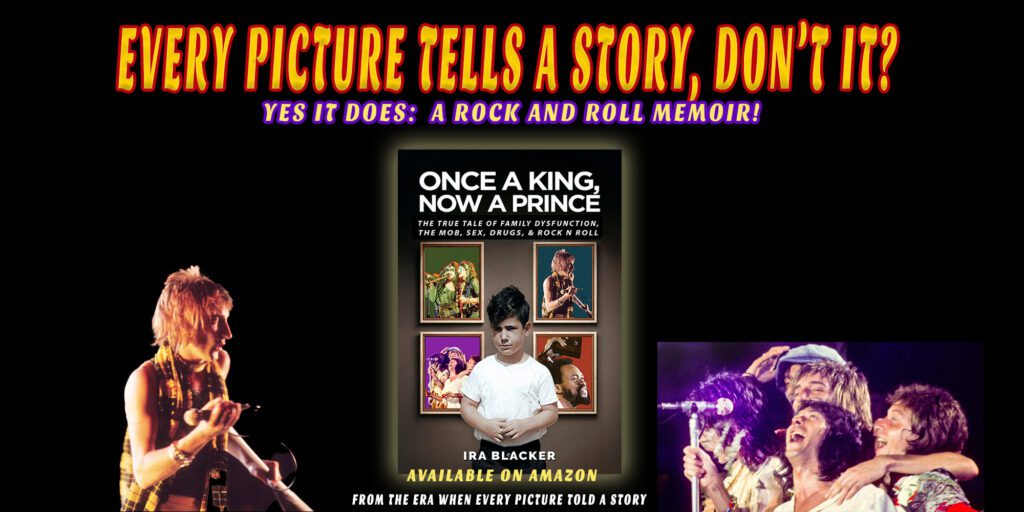
Every Picture Tells a Story… Don’t It?
A rock and roll memoir is not just about the music, and it’s not just about the names people recognize. It’s about the road that led there, the moments that never made the headlines, and the reality behind what most people only saw from the audience. Every picture tells a story, don’t it? In this rock and roll memoir, those stories begin long before the business, before the artists, and before I ever stepped into a position where I could shape anything at all. This is my central rock and roll memoir page, where all my stories and experiences in the music business come together.
My Rock and Roll Memoir Starts With Me As A Child
Like many books about rock and roll history, this rock and roll memoir begins with a kid trying to find something that felt like his own. Growing up in Brooklyn and attending Midwood High School on Bedford Avenue, I started collecting records from the Doo Wop era and beyond, listening to artists like Fats Domino, Chuck Berry, Little Richard, The Paragons, The Drifters, and the blues-driven sounds of Tarheel Slim and Little Annie, and Hank Ballard and The Midnighters. It wasn’t casual listening. I learned who sang what, what style pulled me in, and how each artist carved out a different sound.
That music became an escape from a difficult home life, and it gave me something steady in a world that wasn’t. I would climb up to the roof of my building, spread a blanket on the tar, run a wire down into my apartment, and sit there for hours listening. It wasn’t just about the songs. It was about being somewhere else, even if I hadn’t physically gone anywhere. That early connection is something you won’t find in most books rock and roll fans pick up today, because this rock and roll memoir isn’t looking back from a distance. It’s coming from inside the experience.
Learning the Business: My First Steps Into Music
As that connection deepened, it naturally turned into involvement, and this rock and roll memoir quickly becomes all about the music business as much as it is about the music itself. I took a job at Sam Goody’s in Valley Stream, selling 45s, learning what moved, what sold, and how people responded to different sounds. That led me to produce my first record, “Stormy Weather” by the Five Sharks, which still holds its place as a Doo Wop favorite.
From there, I began promoting local talent like the Four Rays and Little Marty, and even took on the role of MC, learning how to handle a crowd and hold attention in a live setting. Those early experiences were not glamorous, but they were real and the foundation of everything that followed. This is where a rock and roll memoir begins to set itself apart from other books about rock and roll history. It shows how the business actually works, from the ground up, before the names, before the money, and before the leverage.
From Impresario to Manager
Things moved quickly after that. Following the shutdown of the Silver Knight nightclub on Long Island, where I had been promoting shows, I shifted into management and took on a band called The Emeralds. I began placing them in major New York clubs like Trude Heller’s, which brought attention from larger agencies. That led to my entry into Associated Booking Corporation on Park Avenue, run by Joe Glaser, a man whose background in the business was as complex as the industry itself.
My first major signings there were Rod Stewart & Faces and Savoy Brown, and at that point, this rock and roll memoir moved into an entirely different level. It was no longer about getting into the business. It was about operating inside it, making decisions that affected careers, tours, and the direction of the artists themselves.
Building Power in the Music Business
After Joe Glaser’s death, the internal structure of the agency changed in ways that didn’t sit well with me, and I made the decision to leave. That move led me to join Sol Saffian and Jeff Franklin at Action Talent Inc. on Eighth Avenue, where the surroundings were anything but glamorous. One neighbor was Woody Allen, and the rest were working girls, which told you everything you needed to know about where we were starting from.
From there, we rebuilt. Action Talent became American Talent International, and within a short period of time, we turned it into one of the most competitive agencies in the business. We moved into a high-rise on Seventh Avenue near Carnegie Hall, and the operation became exactly what a serious rock and roll memoir should document — the growth, the risk, and the reality of building something in the middle of a fast-moving industry that was still defining itself.
The Artists, The Stories, The Reality
What separates a true rock and roll memoir from a typical music business autobiography is access. The stories that never made print, the moments that happened when the doors were closed, and the reality behind the public image are where the truth lives. The Faces were among my favorite clients, not just because of their success, but because they were genuine and unpredictable. One night in Detroit, after a performance at Cobo Hall, Rod and I ran up 26 flights of stairs to escape a wave of groupies that had spotted us in the hotel lobby. We made it to the rooms just ahead of them, but the pounding on the doors didn’t stop. Those are the kinds of firsthand moments readers hope to find in the best rock n roll memoirs, because they happened away from the stage and outside the official history.

Savoy Brown brought a completely different energy, with a blues-driven sound that could stop you in your tracks, while Deep Purple delivered performances that defined the era, even if dealing with personalities like Ritchie Blackmore required its own level of patience. Rory Gallagher, on the other hand, was one of the most genuine people I worked with, a world-class guitarist whose personal habits ultimately caught up with him. These are the kinds of stories that don’t show up in most books rock and roll fans read, but they are exactly what make a rock and roll memoir worth reading.
What a Rock and Roll Memoir Really Is
At its core, a rock and roll memoir is not about looking back with nostalgia. It’s about documenting what actually happened while it was happening. It’s about understanding that the music, the business, and the personalities were all evolving at the same time, often colliding in ways that shaped what people now think of as history. For readers interested in the music business, or in books about rock and roll history that go beyond surface-level storytelling, this kind of perspective matters. For readers searching for the best rock and roll autobiography, that perspective only works when the stories come from someone who actually lived inside the music business itself.
Where the Story Lives Now
If every picture tells a story, then this rock and roll memoir is the full album. It brings together the experiences, the artists, and the decisions that defined a period when the industry was still being built in real time. For anyone drawn to famous people memoir titles or searching for books about rock and roll history that offer more than a recap, this is not a secondhand account. It is the story of someone who was there, making it happen, one decision at a time. The best rock n roll memoirs preserve more than famous names and performances. They preserve what happened behind closed doors, how decisions were made, and what the people involved were really like.
My Video On YouTube About My Rock And Roll Memoir
