









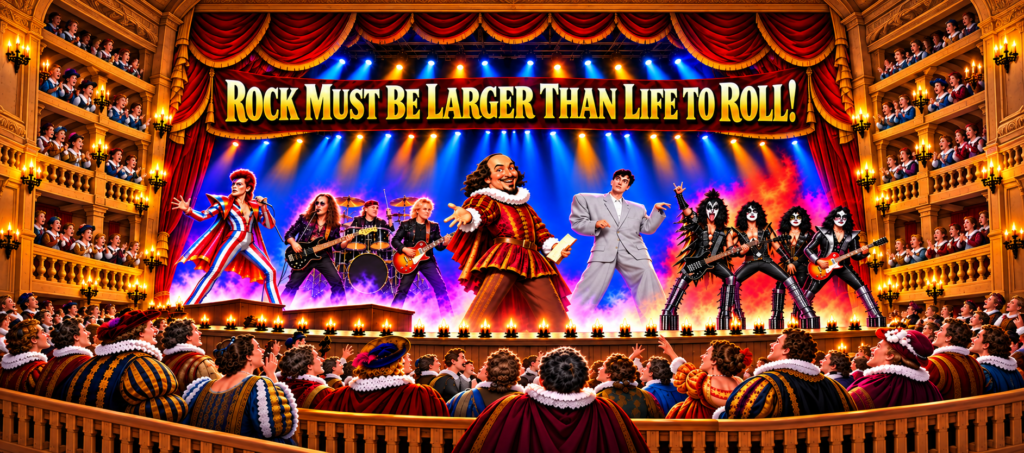
Being 84, one might say I had a front-row seat to much of rock music history as it happened. What I learned from that front-row seat was that the biggest stars were rarely just discovered—they were presented, promoted and built to appear “larger than life.”
A Front Row Seat To Rock Music History
I was there for the rise of Elvis and witnessed how it all began. Later on, as an avid record collector, I became aware that the fifties did not see the start of rock and roll, but that it was the forties with the pop sounds of groups like the Mariners, with “I See the Moon,” and the Mills Brothers, along with Billy Ward and The Dominos, whose music the radio stations referred to as “race music.” Not to forget the blues of Howlin’ Wolf, Joe Turner, and his jump blues style that added to the music. One might even say I had a front row seat to it all. Those sounds were an early part of rock music history long before anyone thought to call them that.
As I grew older, into the not-so-wise age of 15 or so, I started listening to the New York vocal groups, such as The Paragons, Jesters, and the Bonnevilles, with that New York sound of the great bass and falsettos, along with The Teenagers and Students with the “kiddie high tenor lead.” I also loved to listen to the blues transition and blues jump music of the time, such as Tarheel Slim and Little Annie. For me, rock music history was already being written in those records and on those New York streets.
Eventually, I would wind up as the “expert” in the 45rpm department at Sam Goody’s in Valley Stream, Long Island, and would be tipping others to some great tunes, as my local record shop at the Flatbush and Nostrand Ave. Junction in Brooklyn would tip me in the ’50s. Eventually, I would become involved on the business end of music, booking local bands on Long Island and finally moving into New York City, where the major agencies took note of my activities.
One such agency was Associated Booking Corporation, where Joe Glaser, a former mob boss from Chicago, “made me an offer I couldn’t refuse.” My first acquisitions for them were Rod Stewart and Faces, along with Savoy Brown. From there, I founded my own agency, American Talent Int. That move put me inside the business at a time when rock music history was being made almost daily.
When Rock And Roll Became Theater
Due to my position in the music industry, I had “access.” I was privy to things and events that the fans were not. I developed the knowledge and understanding of how things were done and could be done. On one of my trips to London to sign groups and occasionally set up tours for American groups, I went to a show at the University of Oxford, about an hour out from London. It was 1972, and David Bowie was performing there. It is purportedly his “breakout performance.” This was prior to his becoming well known in the music industry. What I saw there became another piece of rock music history that stayed with me.
At the Oxford show, all was very staged and controlled by management, including a photographer who was instructed to capture specific moments, such as Bowie simulating a sex act on stage. The most convincing thing of all was that the hall was packed with “so-called” fans, who applauded and clapped as if on cue. This was rather obvious to me, but maybe not so much to the press invited there.
The bottom line to me about this event was that Bowie’s performance was larger than life, just like a Broadway show, which was a prerequisite for all in theater. P. T. Barnum would have been proud. It was rock music history being shaped not only by music, but by theater, image and presentation.
Creating The Ziggy Stardust Phenomenon
Just like Tom Parker helped create the hype around Elvis Presley and pushed his larger-than-life image, Tony DeFries did the same for Bowie. David Bowie’s manager during the rise of Ziggy Stardust was British music executive Tony DeFries, who represented Bowie from 1971 to 1975. His role in that period of rock music history was not simply managing Bowie, but helping create the perception surrounding him.
DeFries played a major role in shaping not only Bowie’s career, but also the public perception surrounding him. His approach was to present Bowie as a major star before the broader public had fully caught up. The image came first, and commercial success followed. That was one of the lessons of rock music history I understood very well: perception could help create momentum.
Creating the Ziggy Stardust phenomenon and building the illusion of stardom were at play. In 1972, Bowie was not yet earning superstar money, but DeFries made sure he looked like someone who was. Limousines, bodyguards, first-class travel, and other signs of celebrity helped create the impression that Bowie had already reached the top. The public saw the star; those of us inside the business saw another side of rock music history.
Managing the publicity: DeFries understood that too much access could weaken the mystique. Press appearances were carefully controlled, helping make Bowie seem more intriguing and difficult to reach. DeFries’ strategy was simple but highly effective: make Bowie look like a superstar, treat him like a superstar, and encourage the press and public to believe they were witnessing the arrival of someone extraordinary. That kind of planning is part of rock music history just as surely as the records themselves.
Larger Than Life
Tony knew what I also knew, that performers needed to be larger than life; otherwise, how could one distinguish them from members of the audience? Other examples of bands and performers who made it by being so were Kiss, with their makeup and exaggerated poses during their performances, and David Byrne of Talking Heads, who, with his oversized Zoot Suit, knew this and even in interviews espoused his plan to merge rock and theater. These stars became larger than life, and this helped them greatly to launch their careers. Their visual identities became part of rock music history because audiences remembered not only what they heard, but what they saw.
Rush: Theatricality Without Makeup
Not all groups relied on makeup and attire. Rush was one of them. Their place in rock music history developed differently. With the advent of Neil Peart, he made the drum solo an event. He became the Gene Krupa of rock and roll, another memorable piece of rock music history. Peart transformed Rush’s live show by turning the drum solo into a theatrical centerpiece, using his massive 360-degree kit and precise, composed performances to create a visual and musical spectacle that audiences could practically “air drum” along with. That transformation earned its own place in rock music history without Rush ever needing costumes or makeup to do it.
His intricate fills and physical command behind the kit added a new level of excitement to the band’s concerts, while his role as Rush’s primary lyricist introduced themes of science fiction, philosophy, and literature that pushed Geddy Lee and Alex Lifeson toward more complex, cinematic arrangements. Together, those elements helped define Rush’s distinctive blend of hard rock and progressive rock and propelled them into the ranks of global arena headliners. Those are also the kinds of details I believe belong in a rock and roll memoir, because they show how a band evolved beyond the records themselves.
Howie Ungerleider Lights The Show
It also did not hurt to have Howie Ungerleider doing their lighting. Ungerleider was a major part of turning a Rush concert from a band playing onstage into a theatrical production. I placed Howard in that position after he had worked for me at American Talent International, and beginning with Rush in 1974, he designed lighting specifically around the music, using dramatic color changes, carefully timed blackouts, projections, lasers, and later, increasingly sophisticated moving-light and video systems. His work became part of Rush’s contribution to rock music history by making the presentation itself an event.
He experimented early with projected animation—including making the Fly by Night owl appear to flap its wings—and later incorporated film, rear-screen imagery, and elaborate laser effects. His philosophy was that audiences should experience a show, not simply watch a performance; lighting effects were therefore paced and revealed strategically as the concert developed rather than thrown at the audience all at once.
Rush gave him considerable creative freedom, and his designs became an important part of the band’s increasingly cinematic, theatrical identity. That became part of rock music history too—the show had become as carefully shaped as the music. That behind-the-scenes contribution is exactly the sort of thing a rock memoir or rock and roll memoir should preserve.
Creating The Scenario For Stardom
Some of the biggest artists are not just “discovered,” nor do they happen randomly. They are part of a well-thought-out plan regarding their performance, songs, and presentations on stage. All of those that I write about here had one thing in common: management that understood theatricality and being bigger than life onstage, as well as creating an aura of that offstage as well.
These were the heady days of rock music history, typified by a music industry of agents, managers, record executives, and publishers who knew how to help groom a band for stardom, and who knew how to not just make the deals, but also to set up the scenario that made them happen. That part of rock music history rarely happened by accident, and it is one reason a music memoir can tell a different story from the one the audience saw.
This is what Tony DeFries and Tom Parker did, and if I may add here, what I did in the case of Rush, by setting the scene that led to the ease of my facilitation of making the deal I did with Irv Steinberg at Mercury Records for Rush. For me, that is where a rock and roll memoir and rock music history meet: in the things that happened before the public ever knew there was a story. A rock memoir or music memoir can preserve those details, but only if someone who was there tells them.
I created a scenario which made Rush appear, before ever going on stage, “larger than life.”
