









rock and roll history
ROCK AND ROLL HISTORY: IRA BLACKER, RUSH,
KRAFTWERK, AND THE MUSIC BUSINESS
The Record Beyond My Memory
Rock and roll history is usually told from the stage, but some of it was made in offices, airports, hotels, agency rooms, record-company calls, and fast decisions that changed the direction of a band’s life. That is where I lived, and that is why the outside references to my work matter. They do not tell the whole story, and they do not tell the private story, but they confirm that the business side of my life was part of the larger record.
Before Once A King, Now A Prince became my memoir, parts of my life had already appeared in books, articles, archives, interviews, and music-history references. My name appears in connection with Rush, Kraftwerk, American Talent International, Mercury Records, early American touring, and the hard, fast, sometimes brutal business behind rock and roll music. This page brings those references together because rock and roll history is not only made by the people under the lights. It is also made by the people who move records, book tours, take risks, and know when a moment has to be pushed.
I Found Rush Before They Became Rush
The Rush story has been told many times, but the early American breakthrough still matters because it shows how quickly rock and roll history can turn on instinct, timing, radio, records, pressure, and nerve. In 1974, Rush had already made its first album in Canada. The record began catching fire in Cleveland after Donna Halper at WMMS played “Working Man, following my informing her of my activities and requesting she bump it into heavy rotation as a result of my hype,” and that local reaction created the opening the band needed in the United States.
At the time, I owned American Talent International, known as ATI, and I also managed Rush during that critical early American period. Ray Danniels and Vic Wilson came to New York looking for a U.S. booking agency. I heard the album, signed the band through ATI, and sent a copy to Irwin Steinberg at Mercury Records. A Mercury Records press kit from July 17, 1974 documents that Ira Blacker of ATI heard the album, signed Rush, forwarded the album to Irwin at Mercury, and that within days the group was signed. That is not legend. That is part of the documented record. Pictured on the right is Alex Lifeson, 1974. Photo by Ira Blacker.
A 1975 Article Written While It Was Happening
One of the strongest outside references is the January 1975 Canadian Composer article “Living the Rock and Roll Lifestyle,” written by Richard Flohil. The article was written while Rush’s first American push was still unfolding, which makes it especially valuable. It described me as executive vice-president of ATI, a major American booking agency, and described how ATI signed the band and moved the record to Mercury.
The article also noted that after I left ATI and formed my own management company, Rush became one of my first clients. For music business history, that kind of source matters because it was not written decades later with memory doing half the work. It was written at the time, while the road, the record, the deal, and the risk were still alive.
The Toronto Star Oral History
The Toronto Star oral history of Rush from May 2013 is another major outside reference. In that article, Cliff Burnstein of Mercury Records remembers the album arriving at the label and identifies me as the New York ATI agent representing Rush and trying to get them a U.S. deal. I am also quoted directly in the article as Rush’s former agent and co-manager.
That oral history captures the speed and pressure of the moment. Cliff remembered the record coming in. I remembered creating urgency around the band. Geddy Lee remembered how dizzying it felt for young musicians who had been playing bars for years to suddenly find themselves pulled into something much bigger. In rock and roll history, a young band’s future can turn on a phone call, a letter, a meeting, a radio station, or one person deciding the moment has to happen now.
Geddy Lee’s My Effin’ Life And The ATI Trail
Geddy Lee’s memoir, My Effin’ Life, also points back to the early Rush, ATI, and Mercury Records trail. In that account, Cliff Burnstein recalls that Rush’s debut album arrived at Mercury with a note saying it had been sent by a booking agent at ATI. The note said the band was Canadian, hot in Cleveland, and had already sold thousands of copies there (at least according to me).
That reference matters because other Rush histories, contemporary articles, and later oral histories identify that ATI figure as Ira Blacker. Taken together, the sources support the same chain of events: the Cleveland radio reaction, the ATI connection, the album reaching Mercury, and the American deal that helped move the band forward. I do not claim that one person made Rush. That would be false. Rush became Rush because of Geddy Lee, Alex Lifeson, Neil Peart, Ray Danniels, Donna Halper, Irwin Steinberg at Mercury Records, the audience, the road, and the band’s own stubborn refusal to quit. But I did play a major documented role in helping Rush move into the American market, and that truth is strong enough without exaggeration.
Rush Visions, Wikipedia, And Public Visibility
Rush Visions: The Official Biography also documents the ATI and Mercury Records period. It describes ATI talking with Rush management, Ira Blacker, finding and negotiating a record deal, a letter from Blacker accompanying the album sent to Mercury, and Blacker later becoming Rush’s American co-manager. In fact, I was their co-manager prior to this.
Wikipedia’s Rush page also currently includes Ira Blacker in the account of the band’s early U.S. breakthrough, noting that Blacker mailed the album to Mercury Records and later became Rush’s American co-manager. Wikipedia is not the strongest source by itself, but it is useful because it shows that the story has become part of the publicly visible record. The strongest proof remains the period documentation, the Toronto Star oral history, and the Rush biography material.
Ira Blacker, Kraftwerk, And The Wider Music Business
Rush was not the only place where my name crossed into rock and roll history. As a music industry executive, I also appear in references connected to Kraftwerk, including articles and books about the rise of Autobahn and the group’s first serious international breakthrough. Kraftwerk was not just another band. They changed the sound of modern music, and their move toward a wider international audience was part of the larger story of rock and roll music changing shape.
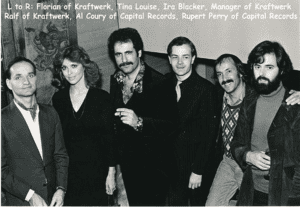
Uncut’s article on Autobahn describes my connection to Kraftwerk’s American representation and touring. Electronic Sound also places me inside that world, referring to Ira Blacker as an American music business manager who met with Harmonia during the period when U.S. record companies were looking closely at German artists after Autobahn. That music business history matters because it shows the range of the work. This was not one band, one deal, or one lucky moment. The 1970s music business was filled with artists trying to cross borders: from Canada into America, from Germany into America, from the underground into the mainstream. I became known as the “king of Kraut Rock.”
Why This Belongs In Rock And Roll History
Rock and roll history is not only made by performers, and saying that does not make the business bigger than the music. It never is. But without the business, many records never reach the audience waiting for them, and many bands never get the road, the label, the push, or the room they need to become what they might become.
Once A King, Now A Prince is not just a private life story. It belongs with music business memoirs because the outside record connects the personal story to the professional one. It is a rock and roll memoir and a music industry memoir from someone who owned ATI, managed Rush, worked inside the machinery, and saw what the public never saw. It is about ambition, instinct, loyalty, betrayal, family, money, pressure, power, and the cost of wanting too much too soon.
The outside references prove that the rock and roll history and music business part of the story was not invented after the fact. Rush histories, Kraftwerk articles, music archives, interviews, and memoir references all point toward the same larger truth. I was in the room. I made deals, took chances, helped move artists forward, and made mistakes along the way. That is why I wrote my rock n roll book the way I did: not as a victory lap, not as a sanitized career summary, and not as a list of famous names, but as a true life story from a music industry executive who lived inside the music business and came out with memories, regrets, scars, and stories that still matter. In a recent post I wrote; “If a tree falls in a forest, and no one is there to hear it, does it make a sound? It is the same with bands. If no one is there for them, their sound goes unheard.
Dear Reader, Do you know who these gentlemen are, what they did in and for Classic Rock, and if you are real astute, and were around in the days when your favorite bands performed in their prime, who the individually were?

The Story Behind The Name Ira Blacker
A name in a book or article is only a trace. It tells you someone was there, but it does not tell you what that person carried, wanted, feared, lost, or regretted. That is what Once A King, Now A Prince is for.
The outside references show where I appear in rock and roll history and untold rock history. The memoir tells what that history cost me.
Selected Outside References To Ira Blacker
Geddy Lee, My Effin’ Life — Confirms the early Rush, ATI, and Mercury Records trail through Cliff Burnstein’s recollection that Rush’s debut album arrived at Mercury with a note from a booking agent at ATI. Other Rush sources identify that ATI figure as Ira Blacker.
Mercury Records Press Kit, July 17, 1974 — Documents that Ira Blacker of ATI heard Rush’s album, signed the band, and forwarded the album to Mercury.
Canadian Composer, January 1975 — “Living the Rock and Roll Lifestyle” — A contemporary article describing Ira Blacker’s ATI role and Rush’s early American breakthrough.
Toronto Star, May 2013 — “Rush: An Oral History” — Includes comments from Cliff Burnstein and Ira Blacker about the Mercury Records deal, the urgency around Rush, and the band’s early American push.
Rush Visions: The Official Biography — Documents the ATI, Mercury Records, and Ira Blacker connection in Rush’s early history.
Wikipedia — Rush — Useful as a public-reference source showing Ira Blacker’s place in the visible account of Rush’s early U.S. breakthrough.
Uncut / More Dark Than Shark — “Kraftwerk: Autobahn and a New Era of Electronic Music” — References Ira Blacker’s connection to Kraftwerk’s American representation and touring.
Electronic Sound — “Autobahn: The Electronic Road Trip” — References Ira Blacker in connection with the post-Autobahn American music-business interest around Harmonia and related German artists.
Our Mind On Music — “Rush: The Long Road to Becoming a Progressive Rock Legend” — A recent supporting article mentioning Ira Blacker as part of Rush’s early professional expansion.