









This music industry memoir comes from firsthand experience inside booking agencies, artist management, touring, and the business decisions that shaped careers during a changing era in rock music. Once A King, Now A Prince is not written from the viewpoint of an observer. It comes from someone who worked directly with artists, promoters, venues, and the machinery behind the public image of the music industry.
There are phrases that feel less like words and more like a backstage pass, and sex, drugs, and rock and roll is one of them. It still carries the smell of amplifiers warming up, hotel corridors after midnight, dressing rooms with too many people in them, and the heavy thud of a bass line before the first chord has even landed.
But in a real music industry memoir, that famous phrase is never the whole story. It became shorthand for a certain kind of rock and roll life, but the reality was wider, stranger, and more human. The public saw the lights, the records, the interviews, and the attitude. What they rarely saw was the machinery around it: the agents, promoters, managers, road crews, label people, hangers-on, dealmakers, and the private rooms where careers often changed direction before anyone in the audience knew a thing.
That is where the real story lives. A music industry memoir can go behind the music industry and show the myth with its pulse still beating, but also with its paperwork, pressure, instinct, ego, charm, fear, and money moving in every direction. It was not just artists behaving badly. It was a world that rewarded speed, appetite, nerve, and access.
Life After The Encore
Once the amps cooled and the crowd spilled into the streets, the real theater often began. Hotels became temporary kingdoms. Lobbies turned into meeting places. Dressing rooms became private little countries with their own rules, their own language, and their own cast of characters.
In a music industry memoir, groupies cannot simply be flattened into cartoons by people who were never really there. In truth, they were part of the ecosystem around touring, fame, loneliness, youth, attraction, and the strange gravity that gathers around performers living outside ordinary schedules. Some were chasing fantasy. Some were chasing access. Some were simply caught in the same current as everyone else.
Sex, drugs, and rock and roll was never neat. It happened in fragments between soundchecks, limousines, backstage calls, late dinners, and sunrise departures. The stories that survived were often the wildest ones, but inside the music business, the more revealing truth was how quickly the extraordinary became routine.
A serious music autobiography cannot treat those nights as decoration. It has to show the emotional velocity of the era: the closeness, the indulgence, the temptation, the boredom, and the hunger to feel something real before the next city swallowed the last one.
The Chemistry Of Escape In A Music Industry Memoir
Drugs were not just props in the old rock and roll story. In a music industry memoir, they have to be understood as part of the environment, not as glitter tossed over a scandal. They played different roles for different people on different nights. Some drugs kept bodies upright through impossible schedules. Some helped people come down after the roar of a show. Others numbed fear, exhaustion, loneliness, or the strange silence that followed applause.
Some drugs, like “La Coca Niña,” were regularly served up at the homes of dealers. One such establishment was “Sandyland,” in the heart of Hollywood, where every night was party night and the party favors were on the house. Many of the greatest names in film and rock and roll were regular guests at Sandyland, named after the occupant, whose usual retort, whenever someone told a bad joke, was, “I tell the jokes.”
That does not make those nights glamorous. It makes them part of the history. The better stories do not brag about the damage. They understand it. A strong rock and roll memoir does not need to dress excess in sequins. It can tell the truth plainly and let the cost speak for itself.
The public often remembers the scandal first, but in a music industry memoir, the scandal is rarely separate from the work. Touring was relentless. Sleep was irregular. Privacy was almost imaginary. Decisions were made in motion, often by people who had not been still long enough to hear themselves think.
That is why the most honest accounts of this world are not merely about indulgence. They are about survival inside a machine that could make you famous, wealthy, adored, and completely unmoored at the same time.
Music As The Center Of The Storm
Strip everything else away and the music remains the reason all of it gathered in the first place. A music industry memoir still has to begin with a song, a performance, a record, a tour, or an artist trying to turn private fire into public sound.
The best stories do not lose sight of that. They understand the grind of rehearsal, the precision hidden inside apparent chaos, the way a riff could appear out of exhaustion, and how one strong performance could make every bad hotel, bad meal, and bad decision seem briefly worth it.
Rock and roll was not simply a soundtrack to excess. It was the engine. It was what gave the excess somewhere to go. Inside the music business, the people who lasted were rarely the loudest ones in the room. They were the ones who understood talent, timing, leverage, and the fragile difference between momentum and collapse.
Some of the most influential people in rock history were not always standing at center stage. They were in offices, backstage corridors, tour buses, label meetings, and agency rooms, shaping the path before the audience ever saw the result.
That is why a music industry memoir can reveal more than a standard celebrity profile. It can show how the room worked, who had influence, who understood the deal, and who knew when the whole circus was about to move to the next city.
Why Readers Still Want The Truth
Modern readers are not looking for fairy tales. They know the old phrase. They know the mythology. What they want now is perspective. A music industry memoir has value because it includes the consequences.
A well-told music autobiography does not simply recount wild nights. It connects them to the relationships strained, the bodies worn down, the deals made under pressure, and the grief that can follow the applause. It shows how ambition and appetite can build a life and then start asking for payment.
That is why Once A King, Now A Prince matters as more than another trip through rock and roll memory. It comes from someone who was close enough to see the machinery working, close enough to understand the personalities, and honest enough to know that the best stories are not always the cleanest ones.
A music industry memoir becomes valuable when it explains what the photographs cannot. Who had power. Who had taste. Who had nerve. Who got lucky. Who paid the price. Who helped shape the culture while the rest of the world was still buying tickets.
A Kraftwerk Photo In A Music Industry Memoir
My choice of Kraftwerk for the main photo here was tongue-in-cheek. As for sex, I was never especially aware of them being chased down hotel corridors by groupies, as Rod Stewart and I were at the Hotel Pontchartrain in Detroit, or dealing with women banging on the band’s hotel doors, or offering sex in the dressing room, as was often the case around Deep Purple’s Ritchie Blackmore.
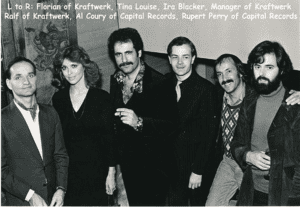
That is part of the joke, of course, but it also says something useful. Not every act fit the cartoon version of rock and roll excess. Behind the music industry, there were many different kinds of artists, many different kinds of fame, and many different ways to influence the culture.
One band that stood as the antithesis of sex, drugs, and rock and roll was Kraftwerk. From my time on the road with them, I never knew them to do drugs.
In a music industry memoir, that kind of contrast matters. The joke lands because it reveals the larger truth: the business contained wildness, calculation, genius, awkwardness, temptation, and theater, often in the same hallway.
The Legend And The Ledger
Long after the lights go dark, sex, drugs, and rock and roll remains shorthand for a moment when restraint seemed optional and volume felt necessary. But a music industry memoir has to do more than repeat the slogan. It has to open the ledger and ask what that life gave, what it took, and who was close enough to understand the difference.
The legend survives because it was real enough to matter. The deeper story survives because it was complicated enough to be worth telling.
For readers who want more than polished nostalgia, Once A King, Now A Prince opens the door to life inside the music business, where the myths were made, the deals were struck, and the human stories behind rock and roll were often more powerful than the noise itself.
A true music industry memoir does not just look at the stage. It looks at the rooms behind it, where the deals, appetites, friendships, betrayals, jokes, mistakes, and memories still echo after the last note is gone.
