








If A Tree Falls In A Forest: A Rock And Roll Book Extra
When telling my stories that are part of the untold side of rock history, I hope you will be informed and entertained as you read things you were unaware of as a fan, and would not have been able to read elsewhere. Here are some new, but old, tidbits for you, and some of the untold rock history that came from living on the business side of the music.
Untold Rock History From The Other Side Of The Desk
One industry true story that belongs to untold rock history, and that you rarely see in the rock and roll stories or memoirs of others, comes from the other side of the desk. Most rock memoirs are written by musicians. The agent’s side is rarely seen, which is why this kind of untold rock history matters.
One story I remember is about one of my favorite artists, Rod Stewart. When Rod and Ronnie Wood joined Faces, the band was not received in the U.K. with anything more than lukewarm reactions. Their gigs were uneventful, and it did not feel as if they would become a major success at all.
As the person who had signed Small Faces when they were represented by Arthur Howes, a top promoter and manager in the U.K. in the sixties, I had set up a great American tour for them because they were already well known from their recordings. It was heartbreaking at first when they broke up, which meant the tour had to be cancelled.
The minute Rod Stewart and Ronnie Wood joined the group, I jumped on a plane to London and met the band at The Dorchester Hotel on Park Lane. I promised them that, unlike many other British groups, I would deliver a tour unlike anything they were used to, and that they would profit rather than lose money. I eventually did. That promise became one more piece of untold rock history, because the public saw the rise but not the work behind it.
According to Louder Magazine, “Ironically, The Faces actually found their strongest early reception in America, and they heavily relied on US tours to build their reputation before eventually winning over the home crowd.” Needless to say, the U.K. and the rest of the world eventually followed suit. I did my job rather well, and I lived up to my promise to them. That is not a boast for the sake of boasting. It is part of the untold rock history of how a band that looked uncertain in one country became important in another.
Rock And Roll Stories From The Faces Tours
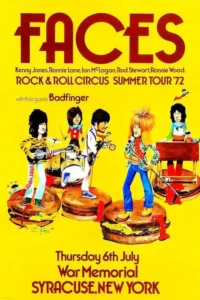
As time and touring progressed, Faces received my utmost attention. I treated them as a favored client. I created special tours, including a Rock and Roll Circus that used a real one-ring circus as the opening act. Later, I had bagpipes open the show in honor of Rod and Mac’s Scottish heritage. Those were not gimmicks for the sake of gimmicks. They were part of the untold rock history of how a tour could become an event.
What actually broke Faces wide open in America was something other agents were not doing. Most used a headliner with an opening act that was usually unknown. I went back to the days of the Alan Freed shows and the R&B touring circuit and created a rock and roll package tour with three bands, all with recognizable names. Faces headlined, Savoy Brown were the special guests, and The Grease Band, formerly with Joe Cocker, were the opening act. The strength of the package made Faces instant headliners before they truly were.
The bottom line is that I used my ability and creative ingenuity to create tours that advanced their career. This is another part of untold rock history because the audience saw the show, but did not see the strategy that made the show matter. Another example came after the package tour, when I strategically chose venues that would create a buzz rather than simply going after the largest concert halls and the biggest payday.
One example was the Boston, Massachusetts, gig. The promoter, whose name I forget, also ran the Boston Tea Party, the Fillmore of Boston. He wanted Faces for the Boston Garden. I booked them through him into the Boston Music Hall, a venue of about 4,400 seats, rather than the Garden’s 20,000.
The result was almost a riot. Crowds of fans who could not get in packed the streets, and somehow found ladders and scaled the building looking for access to the Music Hall. That was not an accident. That was the point of creating demand, and it belongs in the untold rock history of how careers were built before everything became measured by algorithms and instant numbers.
If A Tree Falls In A Forest: Untold Rock History From The Road
Because of my love for Rod and Faces, and because of the work I did for them, I can state quite candidly that, from my vantage point, I contributed considerably to the building of their career. I say this without taking anything away from their wonderful talent. But as the saying goes, “If a tree falls in a forest and no one is there to hear it, did it make a sound?”
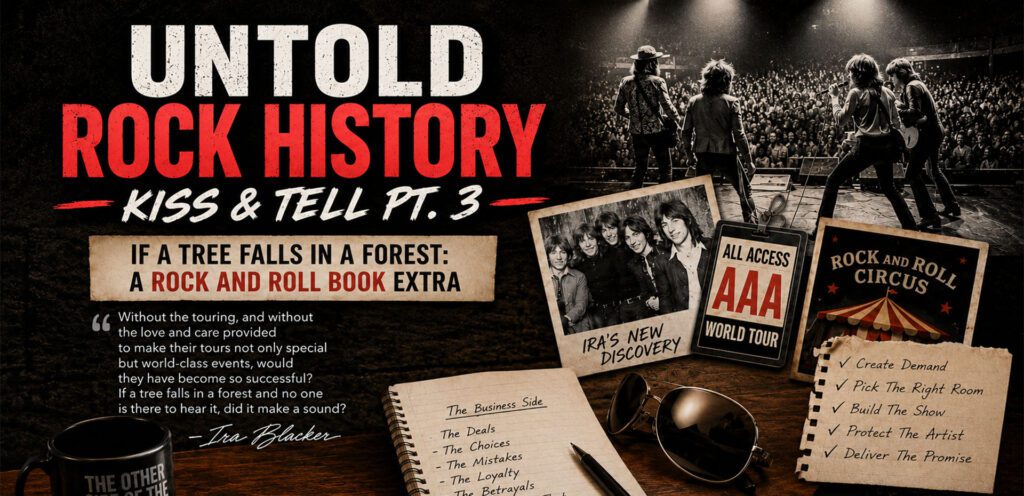
Without the touring, and without the love and care provided to make their tours not only special but world-class events, would they have become so successful? Or, at the very least, would they have become so successful so fast? That is part of the untold rock history I lived, and part of the reason this belongs in a rock and roll book written from the inside.
Forgotten Past: A Music Memoir Addition
When I departed American Talent International, which I had founded, to manage Rush and others, my relationship with the group ended. That ending became another piece of untold rock history, because sometimes the story after the career-building tells you as much as the story during it. When I was completing my memoir, Once A King, Now A Prince, I did not have a direct and recent phone number for Rod. I reached out to his attorney, Barry Tyerman, in Los Angeles, asking that he contact Rod on my behalf and request that, as Nazareth, Foghat, Rory Gallagher, and others had done, Rod provide me with a few kind words for the rear cover of my memoir.
Barry was very kind about it and contacted Rod on several occasions. Rod never replied. How soon they forget. Frankly, after all I had contributed to his career, including the fact that Rod had once asked me to manage him in place of his then-manager, Billy Gaff, I felt absolutely betrayed that he would not help me as I had helped him. This, too, is untold rock history, because the public almost never hears what happens after the lights go down and the favors are forgotten.
Rock And Roll Stories About Forgotten Debts
On another occasion, which frankly suggested the same thing, Rod was rather tight with his desire to help fellow rockers, let alone myself, the guy who helped launch his career. The original three-act package had helped launch Faces in America. On a later tour, I packaged Faces again, and if I recall correctly, J. Geils was in the middle, with Daddy Cool opening the show.
Rod came to me on one of the dates I covered and asked that I fire Daddy Cool because he felt three acts were too many on the bill. He apparently forgot that it was a three-band bill that had helped launch his own career. I reminded him of that fact, and he finally allowed them to finish the tour. How soon they forget, again. These are the kinds of rock and roll stories that rarely make it into a glossy music memoir, but they are exactly the stories that show how the business really worked.
This is one reason a music memoir from the business side matters. The public sees the stage. The public rarely sees the decisions, arguments, favors, and forgotten debts that helped put the act on that stage in the first place. That hidden side is the untold rock history I keep returning to, because it is the part I actually lived.
On another occasion, Jimi Hendrix created the scenario for how musicians should treat one another. He refused to go onstage at Woodstock unless Sha Na Na were allowed to perform. I had a similar incident when some Brooklyn wise guys did not want to pay Buddy Miles for no reason other than the fact that they did not feel like paying a Black artist.
When Buddy came to me, as the representative of the headliners, Savoy Brown, I demanded that Buddy be paid or Savoy would not go onstage. They paid Buddy, who later became a client of mine at ATI. That moment belongs in untold rock history because it shows the difference between talking about loyalty and standing up when it costs you something.
If I Am To Write A Story With Truth, I Betrayed My Friend
I first met Tim Bogert when he was playing at The Action House, when his band was called The Pigeons, and before Carmine Appice became the drummer. I ran into Tim occasionally until Vanilla Fudge broke up and Tim formed Cactus, whom I then represented at ATI. Following that representation, Tim and I became very close friends.
One story I remember him telling me was about his ill-fated trip to England for a tour with Vanilla Fudge. Back in the late sixties and early seventies, it was the thing to pop Quaaludes. Tim had taken two, which was a major dose, and fell asleep while waiting for the plane to depart. Unfortunately, the plane did not depart. There was a sufficient mechanical issue that everyone had to leave that plane and board another.
Unfortunately for Tim, he was out cold and could not wake up enough to walk. As a result, two of the band members from Vanilla Fudge had to carry him off the plane. The only benefit of his being out cold was that he was not awake to suffer the humiliation of the event. It is a small story, but it is also untold rock history, because these were the moments that lived between the official biographies and the backstage truth.
Following Cactus and Beck, Bogert & Appice, Tim had a variety of bands and played locally in Los Angeles while teaching at Guitar Center. I would go to his gigs, and we would hang out. Tim had a major problem with depression at that time, but eventually moved forward and arranged to be married.
I was invited to the wedding, but I did not go to my friend’s wedding. That was an awful thing to do. I was going through a rough patch myself, with divorce and business, and I was suffering from depression at that exact time as well. I failed to communicate that to Tim because I did not have the ability to communicate at all while going through my own bad times.
The bottom line is that I betrayed my friend. I am not proud of that. If I am to write a story with truth, then I cannot only write about the betrayals that were done to me. I have to include the ones I committed, too. That is also part of untold rock history, because the real story is never as clean as the version people prefer to remember.
More Rock And Roll Stories: I Had A “Brainstorm”
While speaking of betrayal, which frankly is a hot button for me, and part of why I left ATI, which was a thriving business, I also committed a minor betrayal while acting as the manager of the R&B/disco group Brainstorm. They had a hit with “Loving Is Really My Game” and recorded for Clarence Avant’s label, which was distributed by CBS.
The only reason I write about this betrayal is that it is a typical rock and roll tale, and it also features Quaaludes. On a night off somewhere in the Carolinas, the group and I went to a local bar. The road manager was buying drinks for this great-looking girl. I started to speak with her, and the next thing you know, I was headed for the door with her, on the way to her place, where I spent the night.
When I was leaving, the road manager informed me that he had been buying drinks for this girl all night long and felt entitled to be the one to leave with her. My reply was short and succinct: “Yeah, but I have the Quaaludes.” Women in those days often considered Ludes the drug of choice. Yes, I betrayed the road manager, but it was a small betrayal.
That, too, is part of untold rock history. Not the polished version. Not the publicist’s version. The real version, and one more reason these rock and roll stories belong in a rock and roll book rather than in the safe version of the music business.
One Last Piece Of Untold Rock History From Canned Heat
In truth, I was not at this event, but it was told to me by another musician during the late sixties. Canned Heat, whom I represented while I was at Associated Booking Corporation, prior to founding American Talent International, was playing one of the Fillmore theaters. As was typical of the times, Henry Vestine, the guitarist, did two things. First, he strung his guitar with banjo strings rather than guitar strings to get more of a blues-type sound. Second, he took some barbiturates. Whether that was to help him hit those late blues notes, simply to get high, or both, is unclear.
As he was sitting in a chair near the edge of the stage playing his solo, he fell asleep from the drugs and fell off the stage. True story? Who knows, but it was going around quite a bit back then, and it belongs with the other rock and roll stories that make up this kind of untold rock history.
That is what untold rock history really is to me. It is not only the famous names, the headliners, or the stories fans already know. It is the deals, choices, mistakes, grudges, loyalties, betrayals, and strange moments that lived backstage, in hotel rooms, in booking offices, in bars, and on the road. Some of it is funny. Some of it still stings. All of it is part of the life behind the curtain.
