







A music agent memoir is not written from the spotlight. It is written from the phone, the routing sheet, the hotel bill, the half-empty weekday that had to be turned into a profitable night, and the instinct that told me a smaller room could sometimes do more for a band than a bigger hall. I was not standing at the microphone. I was trying to make sure the artist looked like he belonged there before the public fully understood what was happening.
That is why this rock and roll story is different from most celebrity autobiographies. The artist can tell you what it felt like to hear the crowd roar. I can tell you what had to be done before there was a crowd big enough to roar. In my world, a career was not built only by talent. It was built by judgment, timing, routing, pressure, nerve, and sometimes the willingness to tell a band that the room they wanted was not the room they needed.
Why Celebrity Autobiographies Often Miss The Agent’s Side
I have read enough celebrity autobiographies to know that the public rock and roll story usually begins after the machinery has already started working. The singer remembers the hotel, the dressing room, the women, the applause, the arguments, and the strange feeling of becoming known. I understand that, because that is the rock and roll story people expect from a celebrity memoir. But from where I sat, the interesting part often happened earlier, when a band was still trying to become important and I had to convince them that I could help make that happen.
When I approached bands that were signed to other American rock and roll agencies, my pitch had to be that the band would gain in their careers. I would let them know that their tours would be fuller, with dates on the hard-to-get weekdays, such as Monday or Tuesday gigs. These gigs helped cover the huge road expenses for hotels and travel. I would further advise them that I would pick the best venues to enhance their career. Sometimes the smaller venue would work better than the larger one.
A Music Agent Memoir: The Competition
The rock agency that was my biggest competitor was Frank Barcelona’s Premier Talent. One of the things I could brag about to young bands was that, as I saw it, Premier’s tours could lose money until the band finally caught on. My groups generally did not. That was not an accident, and it was not just salesmanship. It came from routing, judgment, venue choice, and understanding that a band’s career was not helped by simply throwing it into the largest room available.
That is the kind of thing celebrity autobiographies rarely dwell on, because the artist usually remembers the glory of the tour more than the economics of it. That is not a complaint about celebrity autobiographies; it is simply the difference between living the fame and working the machinery behind it. A band on the road was an expensive machine. Hotels, travel, crew, equipment, commissions, and empty nights could eat away at the romance very quickly. A Monday or Tuesday date was not filler to me. It could be the difference between a tour that looked good on paper and a tour that made sense in real life.
The best music memoirs are the ones that show how success really worked, not merely how it looked afterward. In the agency business, I did not have the luxury of pretending that image and money were separate things. If a band lost too much money before the public caught up, the career could be damaged before it had time to breathe. My job was to help create the appearance of momentum while also keeping the road from becoming a financial trap.
The Rod Stewart Date That Created Demand
At a time when maybe Rod Stewart and Faces could have played the Boston Garden, I booked them into a 3,500-seat music hall. It was safer, because a non-sold-out Garden could have hurt their image as to what they could draw in number of tickets sold. On the other side of the coin, kids were trying to scale the roof with ladders and forcing doors in order to gain entry. That gig made the papers, and it created demand.
That is the kind of agency decision that belongs in a music agent memoir, because it was not only about selling tickets. It was about shaping the rock and roll story before it became public. If Rod had gone into a huge room and left too many seats empty, the talk would have been different. Instead, the room was hot, the demand was obvious, and the newspapers had something to write about. That is how a booking choice becomes part of a career.
Many celebrity autobiographies can tell you what it felt like to be Rod Stewart once the world had decided to look at him. I remember the stage before that, when the decision was how much room to give him, how much pressure to create, and how to let the public feel that they were chasing something already moving away from them. That is one of the oldest truths in the music business, and it is one of the things celebrity autobiographies can miss when the story is told only from the stage. The wrong big room can make an act look smaller. The right smaller room can make the same act look like a sensation.
A Celebrity Memoir Moment When Rod Walked Into Elaine’s
After that gig, Rod became a celebrity. I recall the time when he was at my home on Second Avenue and 92nd Street in Manhattan, and we went to dinner at Elaine’s, one of the hottest venues in New York City at that time. Every head turned as we came in and headed to a table. With Rod, there was no question about getting a table.
That was when I could feel the difference between an act being worked and a star being recognized. No one had to explain anything to the room. The room explained it to us by the way people turned, paused, and understood who had walked in. A celebrity memoir might describe that from inside the fame, but I remember it from beside the fame. I had seen the dates, the routing, the selling, the protecting, and the building. Then suddenly there it was, visible in a restaurant on the East Side of Manhattan.
That is why celebrity autobiographies only tell part of the rock and roll story. The public thinks celebrity happens when everyone notices the artist. I know there were decisions before that moment that helped make the noticing possible. I do not claim to have created Rod Stewart. Rod had the voice, the look, the charisma, and the talent. But I was part of the world that helped put him in the right rooms at the right time, and sometimes the right room was not only a theater. Sometimes it was Elaine’s.
Kraftwerk At Studio 54
A similar thing happened at Studio 54, the hottest club in New York City, when I went there with Kraftwerk. We were waved right in as if we were royalty. That was another one of those moments when you could feel the change in the air. The group was no longer just an act being worked, booked, and moved from city to city. They had become a presence, and the door knew it before anyone had to say a word.
That kind of moment belongs beside celebrity autobiographies, because it shows fame from another angle. Kraftwerk did not have to argue their way in. They were received. That is a very different thing. In the agency business, you could spend months trying to make people understand why an act mattered, and then one night at a place like Studio 54, you could see that the work had crossed some invisible line.
A lot of celebrity memoirs are built around those moments of recognition, but for me the recognition always carried the memory of the road behind it. I remembered the calls, the persuasion, the doubts, the promoters, the competition, and the effort it took to put an act in a position where the door would open that way. That is the difference between watching fame and helping move it into place.
What A Music Agent Memoir Can Tell You
A music agent memoir can tell you that the business was never only business, and the glamour was never only glamour. The two were tied together. If the routing was bad, the glamour suffered. If the room was wrong, the image suffered. If a tour lost too much money, the band suffered. I learned that a career could be helped by the right amount of pressure and hurt by the wrong amount of exposure.
This is where my rock and roll story stands apart from celebrity autobiographies. Readers come to celebrity autobiographies to understand the performer, but I was not trying to remember how it felt to be famous. I was trying to remember what it took to help make fame possible for other people. There is pride in that, but there is also honesty. I saw bands when they were vulnerable, ambitious, nervous, demanding, broke, brilliant, and not yet certain of what they could become.
The best music memoirs do not merely repeat the public legend. They bring the reader into the rooms where the legend was still being argued into existence. In my case, those rooms included agency offices, concert halls, clubs, restaurants, hotel lobbies, and sometimes the door of Studio 54. Those rooms mattered because careers were not built in one place. They were built everywhere a decision had to be made.
The Rock And Roll Story Behind The Public One
The reason celebrity autobiographies continue to interest readers is that people want to know what fame was really like. I understand that completely, but fame was not only a feeling. It was also a construction, a risk, a bet, and sometimes a very delicate illusion. A band had to look big at the right moment, not merely be thrown into the biggest available building because someone wanted to brag.
Rod Stewart walking into Elaine’s and turning every head in the room, and Kraftwerk being waved into Studio 54 as if we were royalty, did not happen in isolation. They were part of the rock and roll story behind the public one. Those moments came after the shows, the choices, the crowds, the articles, the routing, and the belief that the right venue could do more for a career than the biggest venue. Celebrity autobiographies may give readers the star’s memory of becoming famous. A music agent memoir gives them the other side of the door.
Once A King, Now A Prince belongs to readers who want more than the surface version of rock history. It belongs to anyone who reads celebrity autobiographies, follows the old music business, and wants to know what happened before the applause became history. I was there for part of that rock and roll story, and I am telling it from the only place I can honestly tell it: my side of the table.
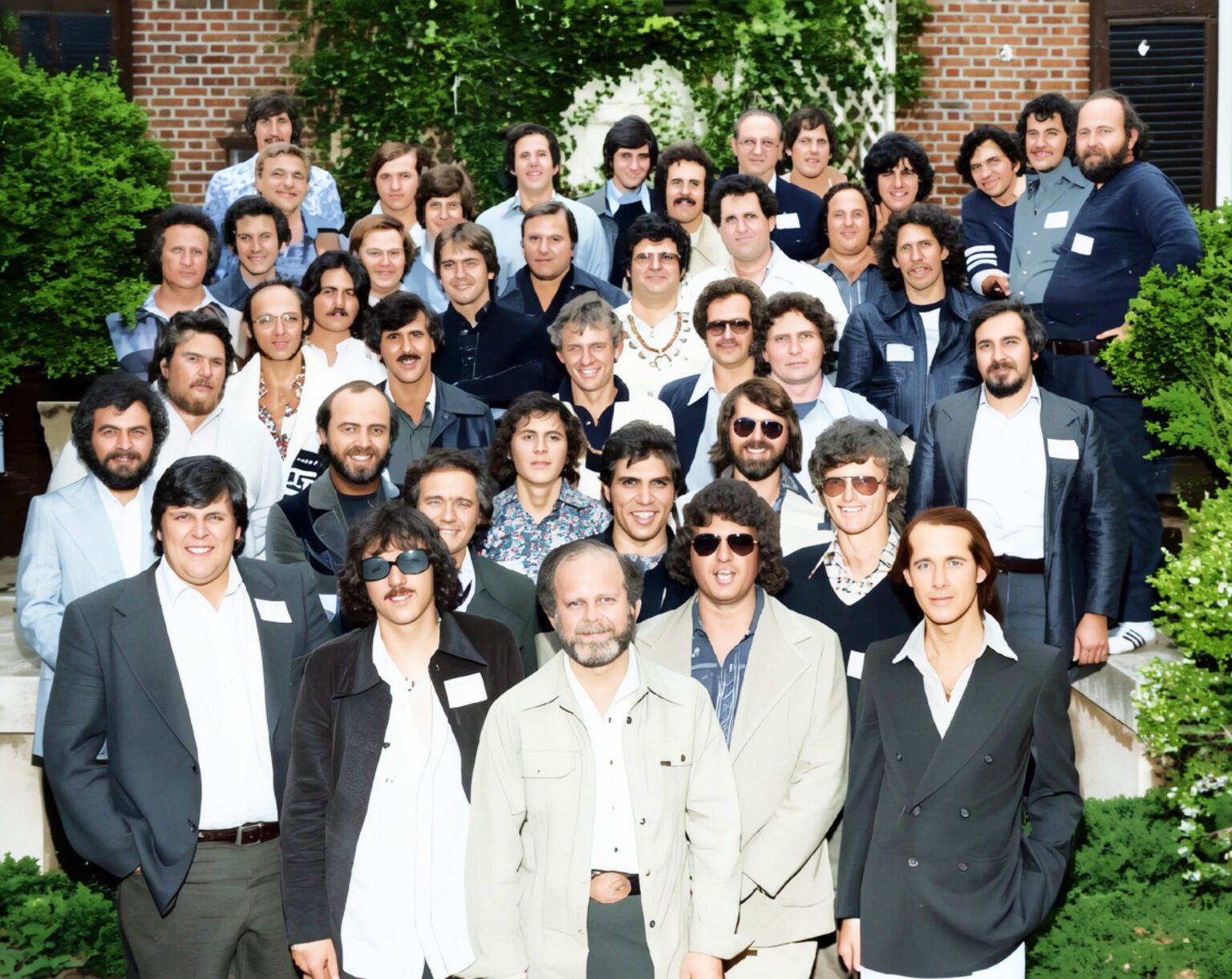
Most of the concert promoters who helped create the super groups of the classic rock era are pictured here at an industry event.