









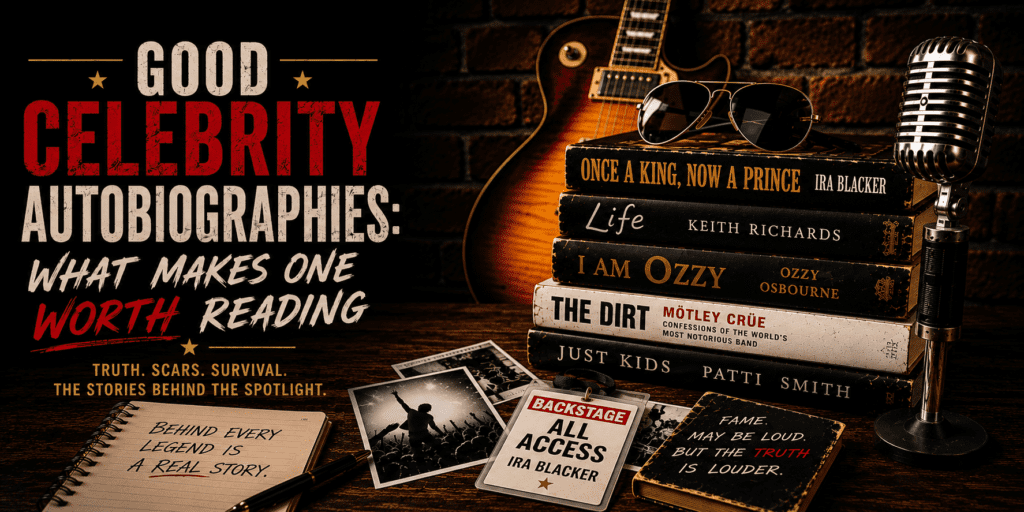
CELEBRITY AUTOBIOGRAPHIES: WHEN FAME TELLS THE TRUTH
What separates good celebrity autobiographies from forgettable ones is honesty, detail, and access to moments the public never saw. Celebrity autobiographies are not worth reading simply because a famous name is on the cover. They matter when the writer, famous or not, is willing to tell the truth when that truth is inconvenient, embarrassing, painful, or impossible to polish into a publicity photo. Fame may get someone through the bookstore door, but honesty is what keeps the reader in the chair.
Once A King, Now A Prince approaches celebrity memoir from the inside, combining personal history with firsthand stories involving artists, managers, tours, and the realities behind the entertainment business. The goal is not mythology. It is reality. Too many celebrity books arrive already embalmed by handlers. The names are recognizable, the photographs are flattering, and the stories have been cleaned until they shine without breathing. Everyone is protected. Nobody is too guilty. The worst moments are softened, the best moments are inflated, and the person inside the book often disappears beneath the career summary.
That is not what makes good celebrity autobiographies worth reading. The best celebrity autobiographies do not feel like monuments. They feel like someone finally pulled up a chair and told you what really happened after the applause stopped, after the hotel room door closed, after the deal was signed, after the marriage cracked, or after the spotlight moved on to someone younger.
WHY CELEBRITY AUTOBIOGRAPHIES NEED MORE THAN FAME
A famous name can sell a book once, but it cannot make the book matter. Readers may arrive because they know the face, the voice, the band, the movie, or the scandal, but they stay because the story gives them something human. That is the difference between a product and a memoir. The same is true of famous people autobiographies: the name may attract attention, but honesty is what gives the book staying power.
The strongest celebrity autobiographies are not afraid of contradiction. They allow the writer to be charming in one chapter and foolish in the next, wounded on one page and arrogant on another. That kind of honesty is what lets a reader believe the rest of the story. A memoir that only shows the author as noble, misunderstood, and endlessly correct becomes suspicious very quickly.
A worthwhile autobiography does not have to confess every sin or parade every private wound for attention. It does, however, have to create trust. The reader needs to feel that the author is not hiding behind the famous version of himself. When that trust is present, even familiar stories feel new because they are being told from the inside rather than from the balcony.
THE BEST CELEBRITY MEMOIR TELLS THE STORY BEHIND THE STORY
The public usually sees the finished performance. A singer walks onstage, an actor enters a scene, a manager makes a deal, a record climbs the chart, and the mythology begins. What the public rarely sees is the fear, exhaustion, calculation, loneliness, resentment, luck, bad judgment, and private damage that helped create the moment.
That hidden life is where good celebrity autobiographies earn their power. The best celebrity autobiographies show what fame did to the person, not merely what the person did with fame. They explain the emotional cost of success and the strange bargain people make when their public identity becomes larger than their private one.
This is especially true in books connected to music. The music business has always sold fantasy better than almost any other industry. It sells youth, danger, freedom, sex, rebellion, genius, excess, and immortality, often while the people inside it are exhausted, frightened, broke, addicted, betrayed, or trying to survive one more tour. That is why a serious celebrity memoir connected to music has to do more than mention famous names. It has to open the dressing room door and let the reader smell the smoke.
WHY ROCK AND ROLL TRUE STORIES STILL HOLD READERS
The best rock and roll stories are not valuable simply because they involve rock stars. They matter because rock and roll was never only music. It was escape, identity, rebellion, business, theater, appetite, and sometimes self-destruction played at maximum volume.
A strong rock and roll book understands that the backstage world was rarely as glamorous as the audience imagined. Behind the lights were contracts, egos, promoters, agents, hustlers, hangers-on, frightened young artists, damaged older ones, and people trying to hold the circus together while pretending the tent was not on fire.
That is why rock and roll true stories can carry more weight than ordinary celebrity anecdotes. A polished anecdote may amuse the reader for a minute, but a true story gives the reader a world. It shows how people behaved when money, fame, ambition, drugs, sex, fear, and survival all crowded into the same room.
The classic rock era still fascinates readers because it feels almost impossible now. There were fewer filters, fewer publicists controlling every sentence, fewer cameras catching every mistake, and fewer corporate brakes on behavior. That made the time dangerous, foolish, funny, alive, and sometimes cruel. The best celebrity autobiographies from that world do not merely celebrate it. They admit what it cost.
THE STORY OF MY LIFE HAS TO BECOME MORE THAN A TIMELINE
Every autobiography is, in one sense, the story of my life, but that phrase only becomes meaningful when the writer understands what shaped that life. Dates are not enough. Jobs are not enough. Famous encounters are not enough. Famous people autobiographies fail when the famous name becomes a substitute for an honest life. A reader wants to know what the author wanted, what he feared, what he misunderstood, what he lost, and what he finally came to see more clearly.
That is where many celebrity books fail. They move from childhood to early struggle to success to downfall to comeback, but they never reveal the emotional machinery underneath. The reader is given events without inner life. The result may be readable, but it is rarely memorable.
The most effective celebrity autobiographies make the past feel alive because the author is not merely reporting it. He is still wrestling with it. Childhood matters. Family matters. Shame matters. The old wounds do not vanish just because the author later entered a famous room or stood beside famous people.
WHY ONCE A KING, NOW A PRINCE BELONGS IN THIS CONVERSATION
Once A King, Now A Prince belongs in the conversation about celebrity autobiographies because it does not begin as a fame story. It begins as a survival story. Before the music business, before the rock and roll years, before the encounters with artists and industry figures, there is a child trying to understand fear, family dysfunction, rejection, anger, and abandonment. That foundation gives the later story its emotional weight.
The book’s subtitle makes the territory plain: “The true tale of family dysfunction, the mob, sex, drugs & Rock N Roll.” It is not pretending to be a polite stroll through show business. It is built around a life that moved from childhood damage into the strange, seductive, and often brutal world behind the music.
That matters because a celebrity memoir without emotional roots can become a scrapbook. The names may be interesting, but the reader eventually needs more than proximity. In Once A King, Now A Prince, the music business is not just scenery. It becomes part of a larger personal journey, one shaped by escape, ambition, insecurity, survival, and the long shadow of childhood.
The book also has something many celebrity-adjacent memoirs lack: a voice that does not sound manufactured. It is direct, wounded, funny, angry, reflective, and at times uncomfortable, which is precisely why it feels human. Readers looking for rock and roll true stories are not looking for another carefully washed corporate memory. They are looking for someone who was there and still remembers what the room felt like.
WHAT MAKES CELEBRITY AUTOBIOGRAPHIES WORTH REMEMBERING
A memoir becomes worth remembering when it gives the reader access to something more lasting than fame. It may preserve a vanished era, reveal the machinery of an industry, or bring famous people down from the poster and back into human scale. But most of all, it must make the reader feel that the writer had something at stake in telling it.
That is why good celebrity autobiographies often contain pain. Not decorative pain, not melodrama, but the kind of pain that explains how a person became who he became. A reader does not need the writer to be perfect. In fact, perfection is usually the least interesting thing a memoir can offer.
The better gift is recognition. A reader may not have lived inside the music business, worked around rock artists, or watched fame operate from behind the curtain. But the reader may understand being dismissed, underestimated, humiliated, frightened, or hungry for a different life. That is where memoir crosses the distance between author and stranger.
THE BEST CELEBRITY BOOKS TELL THE TRUTH WITHOUT BEGGING FOR SYMPATHY
There is a difference between honesty and self-pity. The best celebrity autobiographies do not ask the reader to excuse everything. They ask the reader to understand something. That is a much stronger bargain.
A writer can describe a brutal childhood, a broken family, bad decisions, failed relationships, professional chaos, and personal regret without turning the book into a plea for forgiveness. The stronger approach is to let the facts breathe and let the reader decide what they mean. That kind of restraint often creates more emotional force than any attempt to force sympathy onto the page.
This is why authenticity is now more important than ever. Readers have been overfed on branding. They can smell polish from across the room. They know when a book is protecting an image, and they know when the writer has risked something real.
WHY READERS STILL SEARCH FOR CELEBRITY AUTOBIOGRAPHIES
People continue searching for celebrity autobiographies because they want more than gossip. Gossip is quick sugar. A real memoir is a meal. It gives the reader a life to enter, a voice to follow, and a truth that may not arrive neatly wrapped.
The best celbrity autobiographies in this category are not merely about famous people. They are about what fame reveals, what it hides, and what it fails to heal. They remind us that success can amplify a person without repairing him, and that the applause of strangers does not cancel the private rooms we carry inside ourselves.
That is why a strong rock and roll book can still matter in a crowded field. If it is honest enough, it becomes more than entertainment history. It becomes a record of appetite, damage, invention, survival, and memory. That is also why readers continue searching for famous people autobiographies: they want the person behind the public image, not simply another version of the publicity.
WHY THIS KIND OF BOOK STILL HAS A PLACE
There will always be room for celebrity autobiographies because readers will always want to know what happened behind the official story. They want the unguarded version. They want the moment before the smile. They want the argument after the show, the deal that went wrong, the childhood that never stopped echoing, and the human being underneath the name.
That is where Once A King, Now A Prince, which you will find on Amazon, finds its lane. It is not simply selling celebrity proximity. It is telling the story of my life through the lens of family dysfunction, survival, rock and roll, and the music business world that helped shape the man telling it.
For readers who want rock and roll true stories with grit, humor, damage, and memory still attached, that is what makes the book worth reading. And for readers searching for good celebrity autobiographies, it offers the thing that matters most: not fame polished into myth, but a life told with its bruises still visible.
A Celebrity Memoir Entitled “Once A King, Now A Prince”
