









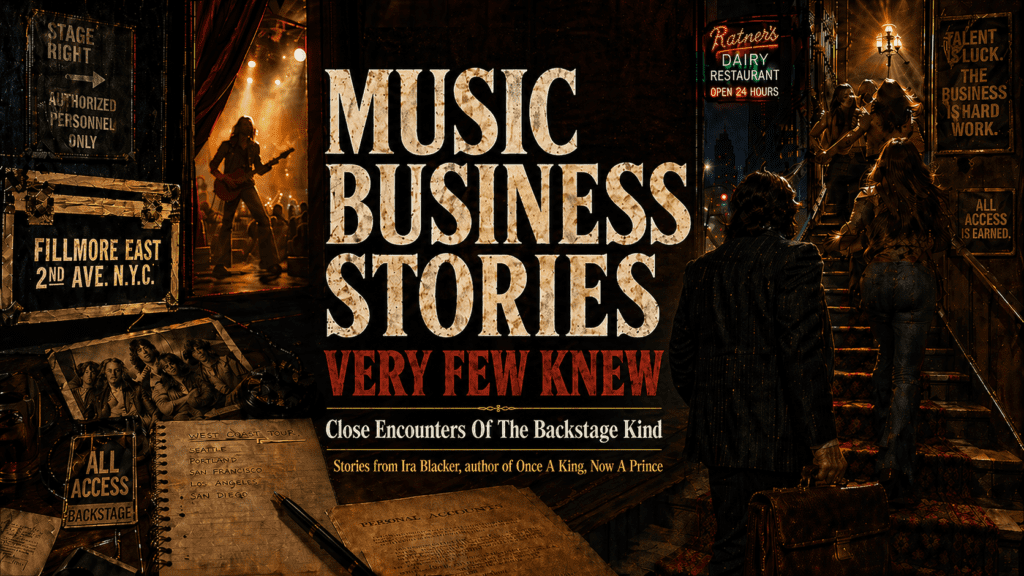
Music business stories are rarely as clean as the legends make them sound. Behind the concerts, contracts, tour buses, and backstage passes, there were strange little moments that revealed the business for what it really was: part strategy, part theater, and part human circus. In Once A King, Now A Prince, I tell these music business stories from the inside, not as a fan looking back, but as someone who was there when the room got loud, the deals got delicate, and the personalities became impossible.
Some of the best music business stories did not happen under the spotlight at all. They happened in stairwells, dressing rooms, hotel lobbies, restaurants, airports, and backstage corners where people were trying to be seen, trying to matter, or trying to get close to the action. This is where classic rock behind the scenes becomes more than nostalgia. It becomes the truth of how the music world felt when nobody was polishing the story for public consumption.
Close Encounters Of The Backstage Kind
I was at Fillmore East on Second Avenue in New York City, next to what used to be Ratner’s Dairy Restaurant, around 1973, along with my then-wife Jean. We were backstage, cheering on Savoy Brown, who was the headliner on the bill, when a groupie came strolling down the stairs into the backstage area, where we were, giving me an all-too-friendly greeting. While I never even knew who she was, and as I was with Jean, the situation was precarious. Jean probably thought, “Who is this piece of trash, and why is she so friendly with my husband?”
At the time, I must have sounded like Jackie Gleason on The Honeymooners, stuttering away when busted by his wife, Alice. I chastised the groupie, who, to make things worse, was wearing a totally see-through dress, fashionable at the time among the famous and the hookers. I guess she felt that since I was a well-known classic rock and roll agent, her desire to look important at my expense was cool. It wasn’t so cool to my wife, Jean, or to me.
Rod Stewart, Me And 26 Flights Of Stairmaster
One of my funniest memories as a classic rock music agent, and one I write about in Once A King, Now A Prince, my memoir of music business stories and more, began with Rod Stewart, a hotel, and a sudden need to run up twenty-six flights of stairs. We were all at Cobo Arena, where Rod Stewart and Faces performed to a sold-out audience. The joint was rockin’, we were rockin’, and some in the audience preferred we keep on rockin’. We drove across the street in our limo, as rock stars did not walk a few blocks, especially after a well-performed show. As our limo pulled up to the Hotel Pontchartrain, we noticed a large group of kids in the lobby. They had not noticed Rod just yet, so we quietly and quickly moved to the elevator bank to get up to our rooms on the 26th floor.
Well, as luck would have it, or not, we were spotted at the elevators by the crowd, who at first slowly moved in our direction, until it became all too evident that a “close encounter of the backstage kind” was certainly going to take place. After I quickly assessed the situation, which entailed yet to arrive, slow-moving elevators, that if we were to make a clean getaway, the stairs, all 26 flights, were the better option. This was a great idea, but not for a not-so-great in-shape classic rock agent. Rod, on the other hand, being an avid amateur soccer player, football to the rest of the world, ran those stairs like a gazelle outrunning an old lion. I, on the other hand, was huffing and puffing until the house could blow me down.
The crowd was close on our heels, but we finally arrived on floor 26, jammed our keys into the lock, entered our rooms, and slammed our doors behind us. It did not end there, or this would now be the end of one of the funniest music business stories I can remember. Once the crowd made it to our floor, with us behind the closed and locked doors, the groupies began knocking, asking for entry, while making promises to both Rod and me about how they would entertain us.
Not All Music Business Stories Were Funny
This was one of those music business stories from classic rock behind the scenes, as I recall, where only the few people directly involved, along with the promoters holding the tour dates, knew what had happened. On one of my many trips to London to sign rock and roll bands, I became aware of Ozzy Osbourne and Black Sabbath, a band I believed could one day become a headliner. One of the reasons for my success in the music business was my keen sense of who would succeed and who would not. I was thrilled at the chance to represent Black Sabbath, and since it was early in my career as the owner of American Talent International, Ltd., I booked an entire tour without a contract, relying instead on a handshake with their then-manager, Pat Meehan.
Pat was a reputed small-time gangster and worked through his company, Worldwide Artists, which played a pivotal role in moving Black Sabbath from UK obscurity toward the American tour I had set up. After my associates and I arranged a national tour of the States, I was informed that Pat had been replaced by Don Arden, Sharon Osbourne’s father, who fancied himself “the Al Capone of London.” I write about Don’s statement in my rock and roll memoir, along with his later meeting with a real American mobster guy I knew.
As my lousy luck would have it, Don decided to move Black Sabbath from ATI to Premier Talent, and there was not a damn thing that I could do about it, without a contract. That was a hard lesson to swallow, but I learned it well, as when the next band came along, all was memorialized on paper, and with a three-year term or more. Betrayal was never something I could ever tolerate, due to my upbringing, and this felt like one of those music business stories where the lesson was expensive, personal, and impossible to forget.
