








How Power and Influence Raised a Small Fortune for Parkinson’s Disease
In the music business, power is usually measured by how many artists you control, how many promoters take your calls, and how quickly you can make something happen. In my years as owner of American Talent International, I had that kind of power. Promoters all over America knew me because they bought my artists, and they knew that when I called, it was usually about business. This music business true story is about one of the rare times I used that position for something that had nothing to do with putting money in my pocket.
By then, I was not some guy hanging around the edges of rock and roll. I owned American Talent International, and ATI had become one of the most powerful agencies in the business, representing artists such as Rod Stewart, Deep Purple, and ZZ Top. I spent my days dealing with the promoters who wanted those artists in their arenas and theaters, and they knew exactly what a call from Ira Blacker could mean. That was the world I operated in, and that was the influence I was able to put behind this music business true story when Parkinson’s disease needed something more useful than another concert booking.
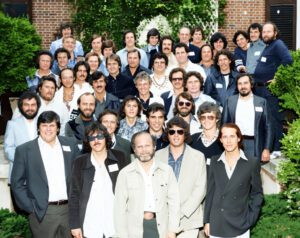
The event was a Parkinson’s disease fundraiser in New York in 1973, held at the Waldorf-Astoria. Bill Gavin was the honoree that night, and William Randolph Hearst Jr. was there in his role as national chairman of the American Parkinson Disease Association. I remember Hearst, I remember the room, and I certainly remember what happened when the numbers were counted.
Of the roughly $85,000 raised that evening, I brought in exactly $78,000. That is the heart of this music business true story, because it was not my own check that created that total. It came from relationships I had built throughout the concert business.
That sum was enormous in early-1970s dollars. In today’s money, my $78,000 works out to roughly $600,000, and the total take for the event was in the neighborhood of $640,000. Those are serious numbers now, and they were even more serious then. That is why this music business true story stays with me. It proved something I had always suspected: the same influence used to sell tours and fill concert halls could also be used, when properly directed, for a genuinely worthwhile cause.
William Randolph Hearst Jr. In The House
The Hearst name, of course, carried a different kind of power. William Randolph Hearst Jr. came from one of the most formidable publishing families in America, but he was not merely coasting on inheritance. He had his own career, his own reputation, and his own standing in public life. He had been a war correspondent, a newspaperman, and a major figure in the Hearst empire.
By the time of that dinner, he was also lending his stature to Parkinson’s disease work, and his presence gave the evening a sense that this was bigger than a routine charity function. It gave this music business true story a larger frame, because the room held not just entertainment people but a man whose name belonged to American history.
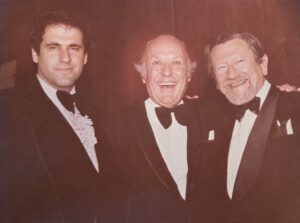
I did not know him well, and I am not going to invent some intimate friendship that never existed. But it was always interesting in those days to find yourself in rooms where old-line American power and the rock-and-roll world crossed paths. That happened more often than outsiders might think. It is one reason this music industry story still interests me. The public tended to imagine the music world as all noise, excess, and madness, yet there we were at the Waldorf-Astoria helping support a serious medical cause, with William Randolph Hearst Jr. right in the middle of it.
What makes this music business true story more than a social memory is that Hearst’s presence underscored what the evening was really about. This was not just a glittering dinner. It was an occasion where people with influence were expected to use it. Hearst used his public stature. I used something far more specific to my own world: the leverage that came from owning a major agency and dealing every day with the concert promoters of America.
The People I Called
The money I raised came from the promoters I did business with all over the country. These were the men who bought my artists, took the risks in their local markets, put up the money, rented the halls, and tried to turn a profit when the show was over. They were not names handed to me from a charity committee. They were part of my everyday working life. That is what gives this music business true story its backbone. I did not go out fishing in unfamiliar waters. I went to the people who already knew exactly who I was and what I represented.
That matters, because the live concert business in those years was not some polished corporate exercise. It was a rough-and-tumble, hard-nosed world, and everybody in it understood the value of access. If you were a promoter and you wanted a major act, you needed relationships with the agents who controlled those acts.
That is where this music industry story gets a little more honest than some people may find comfortable. There were promoters who were used to giving agents cash or favors because they thought that was one way to improve their chances of landing important dates. That was part of the climate, whether polite society liked to talk about it or not.
I was never part of that. I always stuck to my guns, and I always did my utmost for my clients. If I represented an artist, my job was to make the best deal I could for that artist, not to reward some promoter because he had tried to grease the skids for himself. That is another reason this music business true story means something to me even now. The power I had in the business was real, but I did not believe in selling that power for my own private benefit.
A Good Cause, And Human Nature
When the Parkinson’s fundraiser came along, however, I had a use for that influence that I could embrace without reservation. I called promoters and asked them to buy tables or seats for the dinner. I knew perfectly well that many of them were responding to two thoughts at once. One was that Parkinson’s disease was a worthy cause. The other was that helping out might ingratiate them with Ira Blacker. That does not offend my delicate sensibilities. It is what makes this a genuine music industry true story. People are almost never driven by one motive alone, especially in business.
The important thing was that I was not asking them to slip money to me, and they knew it. I was asking them to support a legitimate cause at a prestigious event. If, somewhere in the back of their minds, they thought their generosity might also earn them a little goodwill, so be it. They were not buying my artists, and they were not buying me. They were buying seats and tables for Parkinson’s disease.
That is where this music business true story separates itself from the usual backstage tales in a music memoir. The same currents of ambition, self-interest, and relationship-building that flow through every corner of the business were redirected, for one evening, toward something decent.
In that sense, I was not doing anything mystical or saintly. I was simply taking the reality of the music business as I knew it and using it for a better purpose. I understood the psychology of the people I was calling because I had dealt with them for years. I knew how they thought, what moved them, and how they evaluated an ask. That practical understanding is one more reason this music business true story has lasted in my mind. It was a clear example of what could happen when you took the machinery of the business and pointed it somewhere other than self-enrichment.
The Night The Numbers Came In
At the end of the evening, the total raised was about $85,000, and my share was exactly $78,000. I do not say that to diminish what anybody else did. Plenty of people worked on the event, and it was a collective effort in the broad sense. But the cold arithmetic told its own tale. The concert promoters I approached had provided the lion’s share of the money, and they had done it because the relationships I had built in business were strong enough to produce results. That is what elevates this music business true story beyond mere nostalgia. It demonstrates, in hard dollars, what influence could do when it was put to the test.
If you are writing a rock & roll book, there are plenty of ways to show power. You can show it in sold-out tours, in backstage drama, in artists who dominate the culture, or in the money that changes hands on big deals. Those are all part of the record. But I have always believed that the truer test of power is what happens when there is nothing personal to gain. In that respect, this music business true story remains one of the more satisfying episodes of my career.
I used my position, my contacts, and my credibility to help raise the modern equivalent of nearly $600,000, and not one dollar of it went to me.
That is why the number $78,000 still means something to me. It was tangible proof that relationships in the music business could be worth far more than the next booking or the next commission. They could also be translated into something useful for the larger world. Not every agent had the inclination to think that way, and not every promoter would have responded the same way to every caller. But on that night they responded to mine, and the result was a music business true story I have never forgotten.
What The Business Was Capable Of
Rock and roll in the early 1970s had a reputation for excess, and some of it was deserved. There was money, there were drugs, there were giant egos, and there was enough craziness to fill any number of stories. The outside world often looked at the business and saw only that. What it did not always see was that the people inside it had enormous reach. They could raise money, gather a crowd, and mobilize support in a hurry when they chose to. That is what this music industry true story shows. Beneath the noise and glamour, there was a network of influence that could do more than sell tickets.
For me, that is what gives this episode its rightful place in a music memoir. It belongs there not because it is the wildest story, but because it says something essential about how the business really worked and about how I chose to work within it. The same business relationships that could have been exploited for private favors became, for one night, a force for the good. And if you are putting together a rock & roll book that tries to tell the truth about the era, that is exactly the kind of story that deserves a place alongside the more notorious ones.
There is also a deeper point here. Power, by itself, is morally neutral. It is simply the ability to get something done. In the music business, I had that ability. I could make calls that were returned. I could ask for action and usually get it. This music business true story is valuable to me because it reminds me that power does not have to be measured only by what it can secure for yourself. It can also be measured by what it can accomplish when you decide to use it on behalf of somebody else.
Why I Still Remember It
There were bigger nights in my career in terms of spectacle, and certainly crazier ones. There were artists, tours, fights, triumphs, disasters, and all the rest of the madness that anyone familiar with the period would expect. Yet this music business true story remains one of the clearest memories I have from those years. Perhaps that is because it was so direct. There was no mystery about what had been achieved. A cause needed money. I knew the people who could provide it. I asked, and they came through.
It also remains vivid because it confirmed something about the way I had always chosen to conduct myself. I would not take cash or favors to tilt the scales for somebody in business, but I was more than willing to use the respect, fear, ambition, or goodwill I had accumulated in the industry if the objective was worthwhile. That is what makes this a durable music business true story, and also a revealing music industry story. It shows both the reality of the business and the line I drew within it.
So when I think back on that dinner at the Waldorf-Astoria, I do not think first of tuxedos, celebrity, or society-page glamour. I think of leverage. I think of relationships. I think of what happened when the same force that usually pushed tours and deals was directed toward Parkinson’s disease. That is the reason this music business true story still matters to me. It is a reminder that in a business famous for taking, there were moments when it could also give.
And that, in the end, is why I remember it as the power of a rock mogul used for the good. Not because I suddenly became a different man for one evening, and not because the people I called were transformed into saints, but because the realities of the business were harnessed to do something worthwhile. Hearst brought public prestige to the cause.
Bill Gavin was the honored figure that night. I brought the relationships and the clout I had earned in the concert world. Together, in that room, those forces helped produce a result that still stands as one of the more satisfying chapters in my life: a music business true story in every sense of the phrase.
