








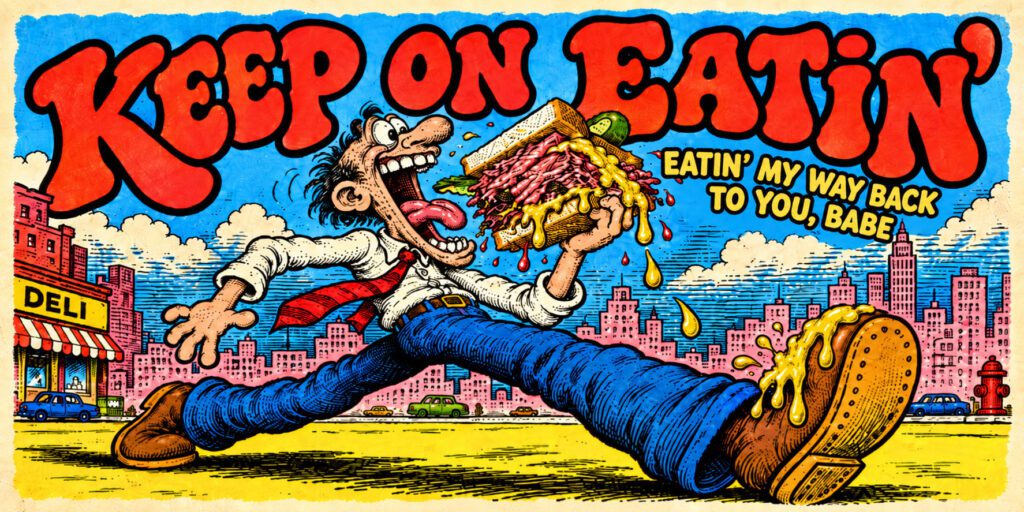
New York Delis And The Food In My Memories
In my original Great New York Delis piece, I wrote about the places, tastes, and traditions that were part of growing up Jewish in New York. That story was really about more than food. It was about neighborhoods, family, memory, and the restaurants that became part of everyday life. This second piece picks up where that one left off, with a few more places that still come back to me whenever I think about the new york delis I grew up with. These are some of the stories from my life that food has managed to preserve better than almost anything else.
For me, pastrami on rye was never just a sandwich. It was the smell when you walked through the door, the pickles on the table, the mustard, the noise, the white aprons behind the counter, and the certainty that somebody at the table was going to have an opinion about whether the pastrami was better here or somewhere else. That was part of New York, and it became part of my life without my ever thinking about it that way at the time. Today people may search for nyc delis, famous nyc delis, or the best jewish deli nyc has to offer. Back then, everybody already had a favorite. When I look back now, I realize that these food memories are woven into the story of my life just as surely as the music business, family, work, and the rest of New York.
Pastrami King Was My Favorite Of The New York Delis
Pastrami King opened on Queens Boulevard in 1956 and became part of the New York deli world I knew. For nearly forty years it served the Kew Gardens courthouse crowd, and the name said exactly what mattered. Pastrami was the attraction, and pastrami on rye was the kind of order that did not need an explanation. To me, it represented exactly what the old new york delis were supposed to be: familiar, unpretentious, and built around food people already knew they wanted.
One old customer later remembered that nothing had ever come close to the taste of that Queens Blvd. deli sandwich. A friend summed up the entire experience in a few words: “Pastrami on rye bread with mustard and pickles on the side.” That is about as close as you can get to the essence of the old New York deli, where the food did not need reinvention because people already knew exactly what they came for.
The food around that sandwich mattered too. Corned beef, tongue, chopped liver, knishes, stuffed cabbage, matzo ball soup, pickles, and rye were all part of the same vocabulary. But pastrami on rye sat at the center of it. You could walk into a deli hungry, order one, and know exactly why you were there. A real nyc deli did not need to make the food fashionable. It simply had to make it right.
Much later, after I had already left New York, the Pastrami King story continued. In 1998 the restaurant moved to Manhattan’s Upper East Side and became Pastrami Queen, a name chosen in honor of the new owners’ family matriarch. In 2020 Pastrami Queen opened another location on West 72nd Street in the former Fine & Schapiro space, where another Jewish deli tradition had existed since 1927.
For me, though, the memory is Pastrami King. Pastrami Queen belongs to the later history of the restaurant, after my own New York years. I can appreciate the continuation, but when I think back, I am thinking about the King and the kind of pastrami on rye that could stay in your head for decades. That is how many of my stories from my life work: one taste or one place becomes the doorway to an entire period I might otherwise have forgotten.
Ratner’s, The Fillmore East, And The Jewish Deli NYC Tradition
Ratner’s was different. It was a dairy restaurant next door to the Fillmore East, so it was not the place to go looking for pastrami on rye, but it was one of my favorites anyway. Ratner’s was geshmacht—great tasting—and I especially remember the blintzes, which still come to mind whenever I think about eating around the Fillmore East.
The location also made Ratner’s part of another piece of my life. The Fillmore East was becoming important to me because of the music business, and right next door was a restaurant serving the kind of Jewish food that connected me to the New York I had grown up with. Those two worlds were sitting beside each other on the same block, and looking back, that connection became another small part of the story of my life.
That is why I never think of these places as only restaurants. Food attaches itself to where you were and what was happening in your life at the time. I can remember a plate of blintzes because I also remember the Fillmore East, the people, the music, and the city around it. A memoir about family, work, and growing up in New York inevitably becomes a food memoir too, because meals were often the background to everything else that was happening. The new york delis and Jewish restaurants I remember were part of the city’s culture, but they were also simply part of my life.
Reuben’s And A Sandwich That Outlived The Restaurant
Reuben’s Restaurant belongs in New York food history for a different reason. Arnold Reuben has long been credited in one version of the story with creating the sandwich that carried his name, although there is a competing claim from Omaha. I am not going to settle that argument here, because what interests me more is how a restaurant can disappear while the food connected to it becomes part of the culture.
Corned beef, Swiss cheese, sauerkraut, dressing, and rye became one of the best-known deli combinations in America. The Reuben was not pastrami on rye, but it came from the same world of substantial sandwiches, strong flavors, and food that did not need to be dressed up to be taken seriously. These were meals built to satisfy you, and nobody had to explain the concept before you took a bite.
That is one reason the old new york delis remain so firmly planted in people’s memories. Restaurants disappear, but the tastes, stories, and arguments over which place did it best can survive for generations. For me, those old restaurants are part of a larger story about family and place, because the food only makes sense when you remember the people and neighborhoods around it.
Carnegie, Stage, And Katz’s Still Belong In The Conversation
Whenever anyone talks about old New York delis, somebody is going to ask about Carnegie, the Stage, or Katz’s. They belong here, but I wrote about them more fully in the original Great New York Delis piece, so I am not going to repeat the whole story. I would rather use them here as part of the larger picture of why this food stayed with me.
The Carnegie Deli was only a block from my office and became one of my regular lunch stops. I remember the enormous pastrami and corned beef sandwiches, the dill pickle, the Dr. Brown’s soda, and the cheesecake. A hot pastrami sandwich there was not something you forgot, and a good pastrami on rye could make an ordinary lunch feel like one of those small New York pleasures that never needed improving.
The Stage Deli had a different personality. It was tied to Broadway and show business, with sandwiches named after famous entertainers and the possibility of looking across the room and recognizing somebody you had seen on television or onstage. It was still a deli, but it carried some of the theater district with it, which made it part restaurant and part New York spectacle.
Katz’s had its own rhythm. The counter, the slicing, the rye, the mustard, and the noise of the room made it feel like a piece of New York that had refused to disappear. For generations of New Yorkers and visitors, pastrami on rye at Katz’s became almost shorthand for the entire Jewish deli experience, and it remains one of the places people mention first when the subject comes up.
Carnegie, Stage, and Katz’s became some of the famous new york delis known far beyond the city, but New York deli culture was always bigger than those famous names. These were the famous names, but New York deli culture was always larger than the famous names. Every neighborhood had its places, and many of those were the ones people remembered most strongly because they were woven into ordinary life rather than saved for an occasion. Those ordinary meals become true life stories later, once enough time has passed for you to understand what they meant.
The Neighborhood Jewish Deli Was Part Of Family Life
You did not always cross town because somebody had published a list telling you where to find the best pastrami sandwich in New York. Most of the time you went to the deli you knew, the one your parents knew, and sometimes the one your grandparents knew. Familiarity mattered because the deli was not only about the food; it was part of the neighborhood and part of the family routine.
Some of the best nyc delis were never famous at all. They were neighborhood places where the people behind the counter might know your family, your order, and probably more of your business than you wanted them to know.
A story about family can begin around one of those tables. You remember who ordered what, who complained, who argued, who reached for another pickle, and who always ordered the same thing. Years later the restaurant may be gone, but the room remains surprisingly clear in your head. That is one reason so many of the true life stories I remember are connected to food. The restaurant gave the family a setting, and the meal gave everyone a reason to sit still long enough for something memorable to happen.
The neighborhood deli was where pastrami on rye could be lunch rather than a destination. You sat down, ordered, ate, talked, paid, and came back another day. Nobody thought they were participating in food history; they were simply eating. Looking back now, that ordinary quality is probably one of the reasons the memories feel so honest. The new york delis were simply there, as much a part of the city as traffic, subways, and everybody having an opinion.
Why Pastrami On Rye Still Means New York To Me
I have eaten good food in plenty of places, but certain foods belong to a city in your head. Pastrami on rye belongs to New York in mine, partly because of the food itself and partly because of everything that surrounded it. The sandwich became connected to a city, a culture, and a period of my life long before I ever thought about writing any of it down.
Good pastrami has smoke, garlic, spice, and enough fat to stay juicy. The rye has to hold up to the meat, the mustard has to cut through it, and the pickle on the side is not decoration. When all of it is right, a pastrami sandwich does not need anything else, which may be why people can spend a lifetime arguing about something that seems so simple.
But the larger reason is memory. Pastrami on rye takes me back to a version of New York where Jewish delis seemed to be everywhere, where the people behind the counter knew what they were doing, and where every neighborhood had somebody willing to argue that their place was better than yours. Those arguments were part of the culture because the food mattered, and the restaurants became part of the way families remembered neighborhoods and periods of their lives. That old jewish deli nyc tradition was about much more than a sandwich. It was food, family, neighborhood, personality, and a sense of belonging all mixed together.
People had loyalties. They remembered how a particular place sliced the meat, whether the rye was fresh, whether the pickles were right, whether the matzo ball soup was worth ordering before the sandwich, and whether a hot pastrami sandwich was better at one deli than another. Those details are the material of true life stories, even if nobody realized it while they were happening. They are also the little details that eventually become stories from my life, because years later those are often the things I remember most clearly.
Eating My Way Home With NYC Deli
When I look back now, food runs through an amazing amount of my New York life. Pastrami King in Queens belongs to the years I remember. Ratner’s sat beside the Fillmore East while music was becoming a larger part of my life. Carnegie was down the street from my office, Stage mixed deli food with Broadway, Reuben’s became part of sandwich history, and Katz’s somehow kept going while so many other places vanished.
Together, those new york delis and restaurants tell part of my own New York story. They were not entries on a tourist list to me. They were places connected to family, work, music, neighborhoods, and different periods of my life.
Some of these restaurants are gone, some moved, some changed owners, and some survived. What remains for me is the food and what surrounded it. I can forget an ordinary day from fifty years ago, but I can still remember a plate of blintzes, the smell of a deli when I walked through the door, or the first bite of pastrami on rye. Those memories have become part of my own memoir about family, New York, work, and the music business because they were there while all of those other parts of my life were unfolding.
Maybe that is why pastrami on rye still feels like more than lunch to me. It carries family, neighborhood, work, music, New York, and a period of my life that is impossible to recreate but very easy to taste. When I write these stories from my life, I keep finding that the food is never far away, because it was there for so many of the ordinary moments that eventually became important memories.
The famous nyc delis may get most of the attention today, but I remember the entire world around them—the neighborhood places, the people behind the counters, the families at the tables, and the arguments over whose deli was better. That was New York.
After all the arguments over who had the best pastrami on rye, who piled it higher, who sliced it better, or which deli deserved to be remembered most, I think the last word should belong to the simplest idea of all. As Michael Jackson almost sang:
“It doesn’t matter who’s wrong or right
Just eat it (eat it)
Just eat it (eat it)“