









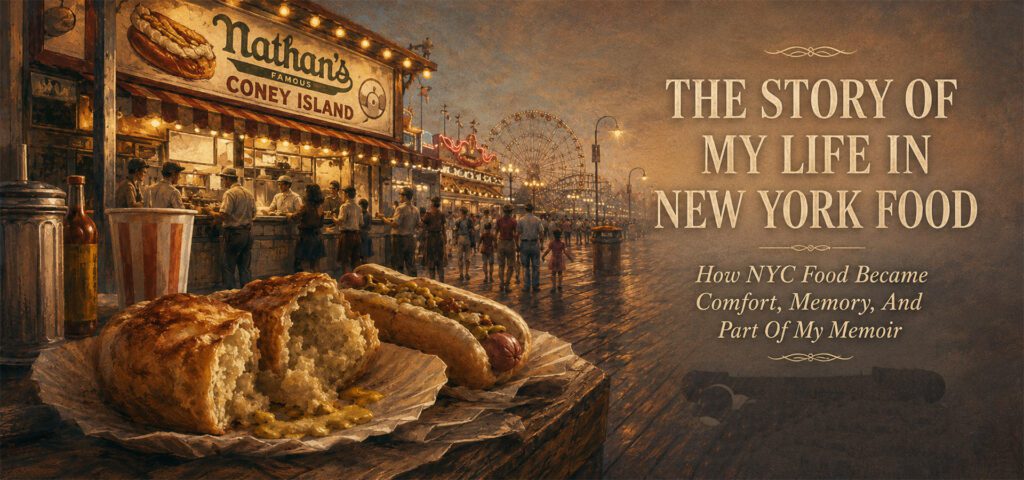
How NYC Food Became Comfort, Memory, And Part Of My Memoir
Writing the story of my life was never something I set out to do as a book. It began as a journal, or maybe more truthfully, as a place to put things I had carried around for too many years. I was not trying to become an author. I was trying to survive the memories. There is a difference, and anyone who has had to drag old pain out of the cellar knows exactly what I mean.
It took me nearly fifteen years to finish what eventually became Once A King, Now A Prince. That was not because I was short of stories. I had too many of them. The problem was that some memories do not sit politely in a chair waiting to be interviewed. They come at you with their shoes on. Some of the traumatic events in my life had to be approached slowly, backed away from, returned to, and written again after I had enough distance to look at them without flinching.
At first, none of this was intended to become a memoir. It was simply a journal, a private excavation, a way of finding out whether all those broken pieces actually belonged to one life. Only later, after friends read some of what I had written, did they encourage me to turn it into a real book. That is how the journal slowly became a memoir, and how the memoir became Once A King, Now A Prince. By the way, I never claimed to be an author, but I do tell a damn good story.
But the story of my life is not only made up of the hardest memories. If it were, no one could bear to write it, and no one should have to read it. A life is also made of smells, rooms, street corners, jokes, meals, bad decisions, good friends, and places that fed you when you had very little else to hold onto.
Food was also my comforter in tough times. I was what people used to call a nervous eater, although I do not remember anyone in my life stopping long enough to ask what I was nervous about. Food became a substitute for love, or at least for the feeling of being soothed. I ate to stuff down the negative emotions and the memories I did not know what to do with. I did not have the words then, and I certainly did not have the tools, so food became one of the places I went when feelings got too loud. A knish, a hot dog, a deli sandwich, a plate of mussels marinara, or a steak could not fix anything, but for a little while it could quiet the noise.
That is why the story of my life can also be told through New York food. Not fancy food. Not food arranged on a plate as if the chef had a nervous breakdown with tweezers. I mean Brooklyn food. Boardwalk food. Deli food. Italian food. The kind of food that came from places with noise, history, attitude, and somebody behind the counter who did not have time for foolishness.
This is not a restaurant review. I am not trying to tell anyone where to eat now, because many of the places I remember are gone, changed, renamed, or swallowed by that great New York monster called progress. This is memory. This is the story of my life told through the food, counters, tables, and rooms that stayed with me.
Shatzkin’s Knishes And Coney Island Food
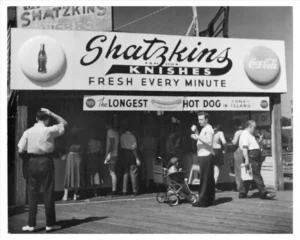
In my memory, Shatzkin’s was the knish place on the Coney Island Boardwalk. Maybe there were others somewhere in Brooklyn, but on that boardwalk, that was the one. They sold knishes, and that was enough. No twenty-page menu. No waiter reciting the private dreams of the chef. Just knishes, hot and solid and New York, the kind of food that did not ask to be admired before you ate it. That was real Coney Island food, not dressed up, not explained, and not separated from the street it came from. You received your fifteen-cent knish, split in half, and shmeared with deli mustard, and you were in heaven.
There were times when I would spend my last fifteen cents, the money that was supposed to get me home from Coney Island to Mid-Brooklyn, on either a Shatzkin’s knish or a Nathan’s hot dog. Once that subway token money was gone, I would walk the several miles home. That probably tells you more about the power of those places than any restaurant review ever could. Desire, comfort, bad judgment, and New York all met in one small coin. That nickel-and-dime arithmetic belongs in the story of my life, because childhood is often measured by what you wanted badly enough to pay for with your feet.
I would have the knish spread with that great Jewish deli mustard. Not the timid yellow stuff that looked as if it had lost an argument with a hot dog, but the sharp mustard that woke everything up. The knish was already good, but the mustard gave it a voice. The whole front of the place seemed to open up, as if the store itself belonged to the boardwalk. You stood there with the Atlantic nearby, the wood under your feet, and New York moving around you like it had somewhere better to be.
Nathan’s And The Boardwalk World
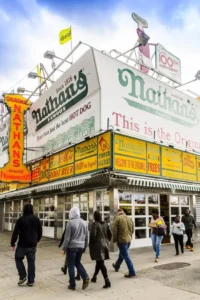
Nathan’s was a different kind of landmark. It was not simply a place to get a hot dog. It was Coney Island’s flagpole, its edible monument, its noisy declaration that this part of Brooklyn belonged to everybody. By the time I knew Nathan’s, it already felt as if it had always been there. That is what the best New York places did. They made you feel late to your own inheritance.
Nathan’s had the same power over me as Shatzkin’s. If I had fifteen cents left, and that fifteen cents was technically my ride home, the hot dog could win. I cannot pretend this was wise, but memory is not built only from wise decisions. Sometimes it is built from mustard, longing, and the reckless mathematics of a kid who wanted one more taste of Coney Island food before going home.
Nathan’s belongs in the story of my life because it was part of the same world as the knish shops, the boardwalk counters, the mustard, the salt air, the crowds, and the feeling that childhood was not protected from the street. In New York, childhood did not arrive wrapped in cotton. It came with noise, smell, appetite, and lessons you were expected to understand before anyone explained them.
Bagels, Delis, Lundy’s, And Wolfie’s
Real New York bagels came from another part of the same world. They did not need to be reinvented, sweetened, perfumed, or turned into dessert with a hole in the middle. A bagel had a skin, a chew, a little resistance. It made you work slightly, which was only fair because New York made you work for everything else.
Delis were the grown-up extension of that education. They were places of appetite, yes, but also performance. The counterman had timing. The waiters had authority. The customers had opinions. The portions had no interest in modern restraint. You went into a real New York deli and understood immediately that food could be memory, identity, family history, and combat sport all on the same plate.
Then there were the places that were not quite delis and not quite formal restaurants, but belonged to the same civilization. Lundy’s had that big-room feeling, the sense that eating could become an outing, an event, almost a civic ritual. Wolfie’s belongs to that same broad Jewish restaurant memory for me, even if it lived in a different geography. These were places with enormous menus, familiar rhythms, and food that understood the people eating it. They belong in the story of my life because they were not just meals. They were rooms where New York explained itself. I fondly remember the Romanian steak at Wolfie’s, a few blocks from Brooklyn College, when my mother would take me there. Today, I believe that cut of beef is usually called skirt steak, but back then, to me, it was simply Romanian steak at Wolfie’s.
Rumpelmayer’s And My ATI Years
Rumpelmayer’s was another New York altogether. It was not Coney Island mustard and boardwalk appetite. It was Central Park South, the Hotel St. Moritz, ice cream, coffee, pastry, polish, and an adult version of New York that seemed to have stepped out of a better-dressed century. As an adult, I loved Rumpelmayer’s. It had atmosphere, and atmosphere matters. Some rooms do more than contain you. They tell you who you were trying to become, or who you thought you had already become.
During my rock and roll years at American Talent International, I lived only a couple of blocks from Rumpelmayer’s, and I went there often. It became one of my grown-up New York haunts, a long way from spending my last fifteen cents on the Coney Island Boardwalk. I even took Kraftwerk there because Rumpelmayer’s was famous for Austrian pastries, and being German, they knew exactly why that mattered.
There I was, a Brooklyn kid who once measured wealth by whether he could buy a knish and still get home, now sitting with Kraftwerk in one of old Manhattan’s elegant rooms over pastries they could appreciate better than most. That is one of the strange turns in the story of my life. You start with mustard on the boardwalk, and if life gets odd enough, you wind up with German electronic music pioneers and Austrian pastries on Central Park South.
Pagano’s, Tony’s, Paul’s, Patsy’s, And The Grown-Up New York Table
During my ATI years, Pagano’s on Lexington Avenue between 85th and 86th Streets had, to me, the best mussels marinara in the world. That is not a casual statement. I have eaten mussels marinara in plenty of places, but Pagano’s understood the whole point of the dish. They served it over a thick slice of great Italian bread, so the sauce had somewhere to go. You did not have to chase it around the plate with a separate piece of bread. The bread was already there, under the mussels, soaking up the marinara like it had been born for the job.
Sol Saffian and I, along with our wives, would regularly go to Tony’s on 72nd Street, right across from the Okinawan karate dojo where I made my first attempt at learning martial arts. That alone says something about that period of my life. There was the music business, there were Italian meals with Sol, there were wives at the table, and across the street there was this other version of myself trying to learn discipline, movement, and how not to get flattened.
Paul’s Steakhouse on 56th and Seventh Avenue had the best porterhouse steak in New York City. That steak belonged to the old Midtown eating world, the kind of place where dinner felt serious without needing to announce itself as important. A little farther west from Paul’s was Patsy’s, on 56th Street between Broadway and Eighth Avenue. Patsy’s was one of the best southern Italian-style restaurants in New York, and back then it was also a regular hangout for wise guys. That was part of its atmosphere, at least as I remember it. The food was real, the room had history, and the customers sometimes looked as if they had brought their own weather with them.
Then there was the Italian restaurant in Italian Harlem where my buddy Carmine “Wassel” DeNoia took me. It was killer. No pun intended. I do not remember the name with certainty, but I remember the feeling of being taken somewhere by someone who knew exactly where to go. Those are different meals. Those are not tourist meals. Those are passport meals, where the person bringing you there is part of the credential.
These places belong in the story of my life because the adult food had its own meaning. The childhood food was about streets, comfort, escape, desire, and the price of getting home. The adult food was about rooms, company, ambition, danger, pleasure, and the odd social geography of New York. By then I was no longer the kid spending his last fifteen cents on the boardwalk, but some part of that kid was still at every table.
Stories From My Life, Told Through Food
I know stories from my life can be told in many ways. Some belong to family. Some belong to fear. Some belong to the music business. Some belong to rooms filled with people whose names later became larger than life. But this story from my life comes through meals, counters, mustard, hot dogs, Italian bread, steak, pastry, and the strange comfort that food gave me when I needed something solid.
If someone searched for my story my life, this is one honest way I could answer. My life was not built in a straight line. It was built in fragments, some painful, some funny, some absurd, and some sitting on a plate in front of me when I needed the world to stop spinning for a few minutes. New York food did not save me, but it steadied me. Sometimes that was enough.
Why The Food Was Never Just Food
The food stayed because the places stayed. Or maybe the places stayed because the feelings did. I remember the mustard because I remember the boy eating the knish. I remember Nathan’s because I remember Coney Island before memory became nostalgia. I remember Rumpelmayer’s because it belonged to a different chapter, one where the kid from Brooklyn had somehow entered a more polished room. I remember Pagano’s, Tony’s, with his signature appetizer, Malutz, which was cooked, and cold whitefish with olive oil and garlic, Paul’s, Patsy’s, and Italian Harlem because those meals were attached to the years when the music business was no longer a dream. It was my life.
That is the real reason to write about the story of my life through food. It lets memory come in through the side door. You start with a knish, and suddenly you are back on the boardwalk. You start with a plate of mussels marinara, and suddenly you are back in the ATI years. You start with Rumpelmayer’s, and suddenly Kraftwerk, from my personal manager years, is sitting in old Manhattan eating pastries. You start with a porterhouse, and suddenly the whole room comes back.
This is not a food history. It is not a map of restaurants. It is one man’s trail through old New York food, childhood comfort, adult appetite, survival, memory, and the need to quiet the noise inside. Food comforted me when I did not yet know how to comfort myself. It gave me something solid when life felt anything but solid.
From New York Food To Once A King, Now A Prince
My memoir, Once A King, Now A Prince, is not about food, but food belongs to the world that made the memoir possible. Before there was a music business story, there was a New York story. Before the backstage rooms, the artists, the deals, the chaos, the mob characters, the laughs, and the damage, there was a boy learning life through family, fear, streets, appetite, anger, and humor.
Readers can find more background about Ira Blacker on the About page, but this piece follows one smaller trail through the life behind the memoir.
That is why the story of my life cannot be separated from these places. Shatzkin’s, Nathan’s, the delis, Lundy’s, Wolfie’s, Rumpelmayer’s, Pagano’s, Tony’s, Paul’s, Patsy’s, and the unnamed Italian restaurant in Italian Harlem were not background scenery. They were part of the education. They taught me how people talked, how people bluffed, how people ate, how people performed, how people hid pain, and how people kept moving.
In the end, maybe that is what all real memoir is. Not a perfect record. Not a polished monument. A trail of places, voices, rooms, meals, mistakes, and moments that somehow add up to a life. For me, some of that trail begins with a hot knish cut in half on the Coney Island Boardwalk, mustard shmeared across the middle, fifteen cents gone from my pocket, and New York all around me.
If you enjoyed this post, you will also enjoy The Great New York Delis
