









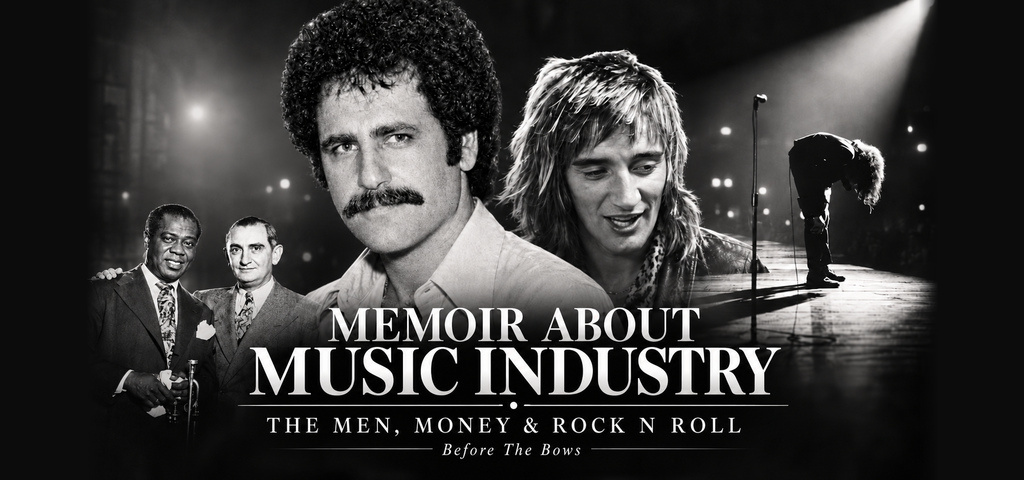
One way to walk away from a good job in the music business is to lose your temper and tell the fellow running the office exactly where he can put the company. I did just that. I had a substantial salary, rock and roll clients who trusted me, and what appeared to be a reasonably secure future. What I did not have was another job waiting or much of a plan for what came next. At the time, I was too angry to appreciate the difference.
That particular act of career advancement belongs in my memoir about music industry life, Once A King, Now A Prince. Long before American Talent International became a name in the rock concert business, I was working among men who had built their careers in another age of entertainment. I was learning when to push, when to listen, when to take a risk, and, apparently, when to open my big mouth. The music brought me into that world. The characters made sure I would never run out of stories.
Working Under Sol Saffian, For Joe Glaser
In 1966, as I was finishing at Hofstra University, Larry Magid suggested I visit Sol Saffian at Associated Booking Corporation. Larry knew I had been buying recording acts for local clubs, and he knew Sol could use help. Sol already knew of me through those dealings. We hit it off immediately, perhaps because we shared that abrasive New York manner which is not always appreciated by people who prefer their conversations wrapped in ribbons.
I went to work under Sol Saffian, for Joe Glaser, who owned Associated Booking Corporation, better known as ABC. The company had roots deep in jazz and the older entertainment business, with a history that included Louis Armstrong, Billie Holiday, Lionel Hampton, Duke Ellington, and other giants. I arrived while rock and roll was changing everything about touring, audiences, and the value of an artist who could fill a concert hall instead of spending a week working a nightclub.
I had come from a childhood in which my father repeatedly told me I was stupid. At ABC, the evidence began to suggest otherwise. By my second week, I had generated more booking offers than anyone else in the office. Within roughly six months, Glaser rewarded me with a substantial bonus and a 50 percent raise. I had finally found a place where somebody judged me by the work I could do, not the child I had been. That contrast, between the frightened Brooklyn kid and the young agent succeeding in a room full of powerful men, is one of the personal threads running through my memoir about music industry life.
Joe Glaser Was Not Your Ordinary Boss
Joe belonged in a Damon Runyon story, except that nobody had to invent him. I would come into work and find the boss sitting at his desk, pounding postage stamps onto envelopes. The agency had a postage meter and plenty of employees who could have handled the mail. Joe evidently preferred to put his own personal whack on every stamp. It was a small thing, perhaps, but a wonderful introduction to how the man viewed authority: if he wanted to do it his way, he did it his way.
His office was a revolving door of entertainers and characters straight out of another era. Muhammad Ali was among the notables who came through. There were men with colorful nicknames, performers whose reputations extended far beyond New York, and enough personalities to keep a young fellow entertained even without an orchestra. The more time I spent there, the clearer it became that my memoir about music industry experience would have to include the people who made the deals, not merely the people who made the records.
“Crazy But A Genius”
Glaser referred to me as “that crazy kid.” He also told people I was “crazy but a genius.” I rather preferred that assessment to the one my father had worked so hard to install in my head. Joe did not necessarily know much about my private life, but he recognized the booking offers, the new artists, and the business I was bringing into his company. We had an unusual relationship. He had a reputation for frightening people, but I was not particularly frightened of him.
I had already attended Joe Blacker’s School of Hard Knocks, and the tuition had been painful. A man raising his voice at me was nothing new. When Glaser yelled, I could laugh and go back to work, while other people seemed to be wondering whether the ceiling was about to fall in. I would not recommend my childhood as management training, but it did leave me with a peculiar tolerance for difficult men. In my memoir about music industry life, that quality was sometimes useful and sometimes a warning sign of trouble ahead.
The Money Had Its Own Set Of Rules
Joe’s relationship with money was an education in itself. In the mornings, he would separate his paper bills into piles of ones, fives, tens, and twenties, then put each denomination into a different pocket. People were always coming to him for something. When one of them came looking for a little cash, Joe could decide which pocket the occasion deserved. It was generosity organized according to denomination, a system I had never encountered in any economics class. That little ritual has stayed with me as one of the more revealing details in my memoir about music industry life.
Then there was the friend of his who was being squeezed by a landlord near Broadway and 58th Street. Joe bought the building, gave his friend a remarkably favorable long-term lease, and sold the property for a profit. He had helped somebody he cared about and made money at the same time. That was Joe. He could be loyal, shrewd, exasperating, and generous without seeing the least contradiction. Those are the sort of incidents that make a memoir about music industry personalities more interesting to me than a tidy recital of record sales.
Many music business autobiographies understandably concentrate on hit records, famous faces, and glamorous evenings. I enjoyed those evenings myself, but my education also happened in offices where a stack of bills or a real-estate transaction could reveal more about a person than a press release ever would. Old show business was full of men who understood friendship, loyalty, and leverage, though not always in that order.
Rock And Roll Was Changing The Rules
Associated Booking represented artists who had helped create rock and roll, but many of them were still being booked into grueling club engagements, working several sets a night for a full week. Fats Domino, Little Richard, B.B. King, and others had changed the music of an entire generation. Yet the rock ballroom circuit, packed with younger audiences, was opening a different opportunity. I thought those audiences should hear the artists who had helped start it all.
I broke up a week’s bookings in Chicago to arrange a Fillmore East appearance for Fats Domino. I also did something we were not supposed to do: I called Fats directly. He was happy to take the engagement, but the agency was not happy about losing a week’s commission. I saw a bigger picture. If I could get those performers before the rock audience, there would be more dates, new markets, and a new chapter in their careers. That decision remains one of the parts of my memoir about music industry work of which I am proudest.
Bill Graham’s Fillmore operation was important because promoters elsewhere paid attention to what he booked. Once a name appeared on a Fillmore bill, other buyers often followed. I helped bring artists such as Bobby “Blue” Bland, Howlin’ Wolf, Ike and Tina Turner, Little Richard, and B.B. King into that world. The stories of the performers belong to them, but the business decision was mine to make. This memoir about music industry change is also about trusting your ears when the conventional wisdom tells you to leave well enough alone.
The Day The Boss Died And Everyone Counted The Money
I liked Joe Glaser. He was good to me, generous with his rewards, and willing to let me take chances that might have sent somebody else out the door. I also understood that others had different experiences with him. When Joe died, I attended his funeral, after which we gathered at a Chinese restaurant near the office. There should have been room for grief. Instead, I watched people concern themselves with his will and the distribution of what he had built.
It was a feeding frenzy, and not because the food was particularly good. Sol believed he had been promised a piece of the agency, but Joe’s death had ended that possibility. Other people were dissatisfied with what they had received. What troubled me most was how little anyone seemed to care that Joe was dead. I did. It may not have been fashionable among the disappointed heirs and employees, but the man had treated me well, and I felt his loss.
That afternoon revealed something I had not learned from booking acts or negotiating commissions. The same people who gathered around a powerful man while he was alive could become remarkably interested in his possessions once he was gone. My memoir about music industry relationships includes that unpleasant lesson because it says as much about the business as a successful concert ever could. There was loyalty in those offices, but there was also ambition, envy, and an extraordinary ability to count money through one’s grief.
An Accountant, A Missing Secretary, And One Terrible Temper
Following Glaser’s death, Oscar Cohen was running ABC. He then left on a six-week trip and put his friend, the accountant Dave Gold, in charge. Around that time, my secretary became seriously ill. She would eventually die, but during her illness I kept requesting temporary help so I could take care of the work that was piling up. Gold repeatedly refused. I was representing important acts, business was coming in, and I could not get the temporary assistance I needed to keep the work moving.
I became increasingly frustrated until the last refusal pushed me over the edge. I told Gold to take the company and shove it up his ass, then walked out. No farewell speech, no carefully negotiated exit, no alternative offer safely tucked away in my pocket. I had an excellent salary and a thriving career and had just placed both in jeopardy. As I describe in my memoir about music industry life, I was about twenty-seven and being driven by my temper rather than my brain. That distinction would have been considerably more useful to recognize before opening my mouth.
Once I got home and the temperature came down, I began calling the people whose careers depended on my work. Billy Gaff, who managed Rod Stewart and the Faces, and Harry Simmonds, who managed Savoy Brown, were among the first. I wanted them to understand that although I had walked out of ABC, I intended to continue working for them wherever I landed. That was not just professional courtesy. Those relationships were the foundation of anything I might build next. They were also a reminder that a memoir about music industry responsibility cannot be told entirely through one’s triumphs.
Rod Stewart? There Is An Opening In The Mailroom
I began looking for a place to land. A conversation with a friend at General Artists Corporation did not lead anywhere. When I contacted another major agency, the fellow in its employment department seemed to have little appreciation of the clients I represented. He offered me a position in the mailroom. Here I was, booking Rod Stewart and other rock acts, and somebody wanted me to begin my future career distributing the mail. I was not especially inclined to accept the promotion.
It was one of those moments in which you discover that your reputation does not necessarily travel ahead of you. I had been a success at ABC, yet I was suddenly explaining my worth to people who did not appear to understand what I did. My memoir about music industry reversals has no shortage of comedy, although I did not find every scene amusing while it was happening. I needed an agency, my artists needed an agent, and pride was not going to pay anybody’s bills.
The Rock And Roll Package That Helped Build ATI

I called Sol Saffian, who had left Associated Booking shortly after Joe’s death. Sol invited me to meet him, Jeff Franklin, and Betty Sperber at Action Talent. Betty owned the company, whose business at the time leaned toward the bubblegum acts of the day. I joined and promptly created the title of head of progressive rock for myself. I even sent out a press release announcing the new department without clearing it with Sol, who had been functioning as the head of that side of the operation. He was not exactly delighted by my initiative.
There was still the question of getting enough strong attractions on the road to make the agency matter to promoters. Sol understood the old package-show business, and we put together Rod Stewart and the Faces, Savoy Brown, and the Grease Band, whose work with Joe Cocker gave the opening act a recognizable name. It was a bill that could fill an auditorium, and the promoters responded. We finally had the sort of show an agency could build upon rather than simply hope would catch fire. That is a part of my memoir about music industry life where the music and the business instincts came together just as they should.
As Betty prepared to move on, Sol, Jeff, and I had to decide how to reorganize the company and handle the financial risks. We were not three gentlemen sitting comfortably over cocktails with an empire already in our pockets. We were trying to create something lasting while dealing with debts, uncertainty, and personalities that were not always in agreement. Eventually, that undertaking became American Talent International. The success was real, but so was the risk. My memoir about music industry ambition is not a story of getting everything right; it is a story of carrying on when much could still go wrong.
The Man Behind The Deals
When readers search for the best rock and roll autobiographies, the famous performers are understandably part of the attraction. But I was on the other side of the stage. The interesting questions for me were how the artists got the dates, how a tour was assembled, how a difficult personality could change a deal, and how a decision in a small office could help move an entire career forward. I loved the music, but I was also fascinated by the machinery that made it possible for an audience to hear it.
My memoir about music industry life did not begin with Associated Booking or end with the creation of ATI. It began with a boy in Brooklyn who had spent much of his childhood looking for somewhere he belonged. Music eventually provided that place, even if the business surrounding it sometimes resembled the world of angry, unpredictable adults I thought I had escaped. I had survived one kind of turmoil only to choose a profession that could produce another. At least this time, much of the noise was worth listening to.
That is why Once A King, Now A Prince is more than a music business autobiography about contracts and commissions. The personalities, the humor, the anger, the loyalty, and the occasional complete lack of common sense are all part of the same life. My memoir about music industry experience offers the view from the rooms where careers were made, money changed hands, and the people making the decisions were often every bit as entertaining as the people appearing onstage.
The old rock and roll business was not a neat, well-behaved place, and neither was I. I had my successes, made my mistakes, and met characters no novelist would dare invent. If you want a memoir about music industry life with the curtain pulled back, the real show was often happening long before the band plugged in.
