








I never set out to write a book. That may sound strange coming from somebody who eventually spent almost fifteen years writing one, but it is the truth. Once A King, Now A Prince started as a journal. Nothing more ambitious than that.
I was not sitting there thinking about publishers, readers, reviews, podcasts, or whether anybody in the world would give a damn about what I had to say. I was writing for myself. Maybe even writing to myself. There were things I had carried around for most of my life that simply needed someplace else to live. Memories, anger, questions, people I loved, people I hated, things that happened to me, and things I did to other people. There were successes I was proud of and mistakes I would have preferred to leave buried. Unfortunately, memories do not always cooperate. Some of them keep knocking on the door until you finally answer.
Why Music Memoirs Begin Before The Music
My story did not begin with rock and roll. It did not begin with Rod Stewart and Faces, Deep Purple, Rush, Kraftwerk, Nazareth, Uriah Heep, ZZ Top, or any of the other people I would eventually encounter during my years in the music business. Like many music memoirs, mine really began long before the music. The more I wrote, the more I understood that music memoirs do not begin with the first record, the first tour, or the first deal.
It began much earlier, with a little boy growing up in what I can only describe as a war zone. My mother loved me. My father did not want me. That is a hell of a sentence to write, and it is an even harder sentence to live. When you are a child, you do not have the ability to sit back and analyze your parents. You do not say, Dad seems to be having emotional difficulties today. You think it is you. You think somehow you caused it.
My father’s anger filled our home. My mother’s love was real, but it could not protect me from everything that was happening around us. Eventually, I was sent away. The adults may have thought they were solving a problem, but the six-year-old boy did not see it that way. He saw abandonment. He saw himself being removed from his own home while the adults stayed behind. Somewhere inside that child, a message began taking shape: Maybe I really am the problem.
That message can follow you for a very long time. It followed me into friendships, relationships, business, ambition, and my need to succeed. Probably into more arguments than I care to admit. I spent a good portion of my life proving that I mattered without ever completely understanding who I was trying to prove it to.
When Rock And Roll Found Me
Then, at fifteen, I found rock and roll. Or maybe rock and roll found me. I used to go up on the roof of my building in Brooklyn, spread out a blanket, run an extension cord down to my bedroom, plug in the radio, and listen. Up there, I could escape for a while. The music did something for me that very few things could do at that point in my life. It gave me another world.
Years later, that world became my business. I went from managing a local group to becoming an agent, and from there into a life I never could have imagined while I was lying on that rooftop in Brooklyn. Suddenly I was dealing with artists, managers, promoters, record companies, tours, contracts, egos, money, arguments, triumphs, betrayals, airplanes, hotel rooms, and enough insanity to keep a psychiatrist employed for several lifetimes.
And yes, it was exciting. There were incredible times and some very funny times. There were also times when I acted like an asshole. Anybody who writes a memoir and somehow manages to make himself the hero of every chapter has either lived a very unusual life or has a very convenient memory. I was not interested in doing that. A music autobiography that leaves out the mistakes may make its author look better, but it does not necessarily make the story better. The same is true of music memoirs. If everything comes out clean, heroic, and flattering, somebody probably left out the interesting parts. Music memoirs need the screwups as much as the triumphs.
From Journal To Music Memoir
Remember, I did not start this as a book. I started it as a journal. And when you are writing something you believe nobody else is ever going to read, there is very little reason to bullshit yourself. That became important later. Friends eventually read some of what I had written and told me there was a book there. I was not convinced. I have never claimed to be an author, but I can tell a damn good story. So, I kept writing.
What had started as a journal about my childhood slowly became much larger. My early adulthood came into it. The music business came into it. The people I had known came into it. The mistakes came into it. Pretty soon, I realized that if I was going to tell the story, I had to tell the truth. Without quite realizing it, the journal was becoming a music memoir, and eventually one of those music memoirs in which the life outside the business mattered as much as the life inside it. Not somebody else’s truth. Mine.
That does not mean memory is perfect. Anybody who tells you he remembers every conversation from fifty years ago word for word is either blessed with a supernatural brain or full of crap. But there is another kind of truth. Emotional truth. You remember how something felt. You remember the room. You remember the fear and the anger. You remember who stood beside you and who disappeared when you needed them. You remember being betrayed, and you remember being loved.
The Truth Inside Music Memoirs
The challenge was learning how to write all of that without turning the book into revenge. Believe me, there were opportunities. There were people I could have destroyed on paper if that had been the purpose. But revenge makes lousy history. And it makes lousy music memoirs too.
What I really wanted was to understand how I got from that frightened, angry little boy to the man who eventually sat across from some of the biggest names in the music business and made decisions that affected careers. Because that boy never really disappeared. He came with me.
The same kid who once wondered why his father did not want him became a man with a tremendous need to win, to matter, to be respected, and to control the room before the room could control him. That can be a very useful quality in business. It can also get you into a lot of trouble. I managed both.
That, to me, is where music memoirs become more than collections of backstage stories. A music business memoir can tell you who was there, what happened, and which deals got made. The more difficult part is admitting what you carried into those rooms with you. The best music memoirs should do both. Otherwise, music memoirs become résumés with better anecdotes.
Writing the journal made me see connections I had never seen while I was living them. That may be one reason music memoirs can reach beyond the music itself. That may have been the biggest surprise of all. You live life going forward, but when you write about it, you are looking backward. Suddenly, things that seemed unrelated started connecting. The anger connects to abandonment. The ambition is connected to rejection. The humor connects to pain.
And yes, I use humor. I always have. Sometimes humor is simply the only civilized response to insanity. If I told some of these stories without laughing, I would probably have to start throwing furniture. Music memoirs without humor can get awfully heavy, especially when the life behind the music was heavy enough already.
What The Book Became
So, the book became many things. It became a record of my family. It became a record of a New York that barely exists anymore. It became a record of the music business during an extraordinary period when rock and roll was exploding, and nobody really knew where the hell it was going.
It became a record of people who became famous, people who disappeared, people who mattered to me, and people I wish I had never met. But underneath all of that, it remained what it had been in the beginning: a journal. A man trying to understand his own life by putting it on paper.
Maybe that is what music memoirs finally become when they are honest: not simply stories about music, but stories about the people we were before the music, the people we became because of it, and the parts of ourselves that never went away. Music memoirs may start with famous names, tours, records, deals, and backstage stories, but those things are only scenery if the person telling the story never shows up.
I think that is why telling the truth matters so much to me. I was not interested in polishing myself for public consumption. Life was not polished. Mine certainly wasn’t. There was abuse. There was abandonment. There was sex, drugs, and rock and roll. There was success and failure, laughter and betrayal. There were people I loved desperately, and there were people I would have gladly helped onto a slow boat to China, preferably without a return ticket. That is life. Warts and all.
And now, after all those years of writing something I never planned to write, the journal has become a book. And the book has found readers. That still amazes me. Because somewhere underneath the stories about famous musicians, agents, managers, promoters, record companies, deals, tours, and all the madness that came with them, there is still that little boy wondering what he did wrong. The difference is that today I can finally answer him. He did not do anything wrong. He survived. And then he had one hell of a life.
Perhaps that is why I finally understand the value of music memoirs. Good music memoirs do not just preserve a career; they preserve the person who lived it. You start out thinking you are writing down what happened. If you are lucky—and truthful enough—you eventually discover why it mattered. For me, that is the difference between a collection of rock-and-roll stories and music memoirs that actually mean something.
So, if there is one thing I learned from writing mine, it is this: You do not have to set out to write the story of your life. Sometimes you simply start telling yourself the truth. And one day you look down at all those pages and realize there was a story there all along.
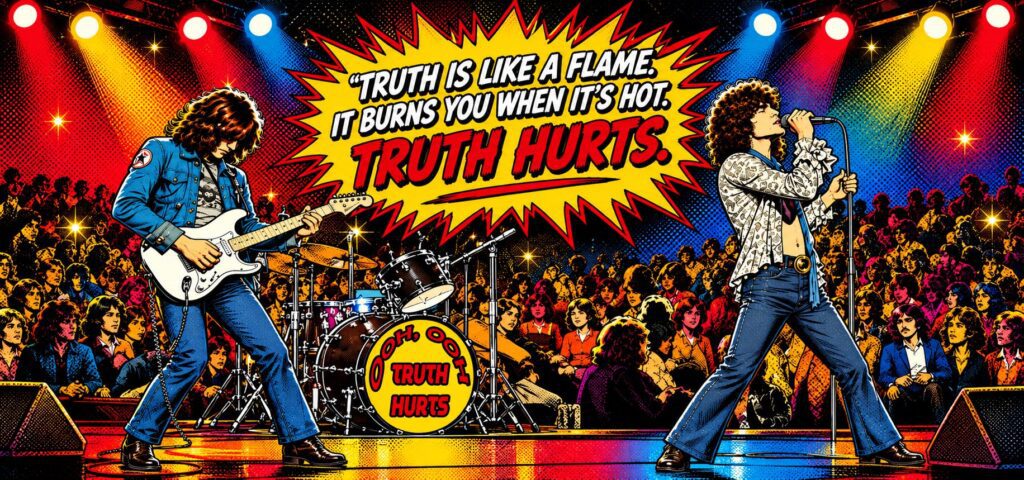
“Truth is like a flame. It burns you when it’s hot. Truth hurts“
