








In The Beginning, There Was A Child
When the crafters of rock and roll insider stories craft their works, you will not usually see much about the Wonder Bread years, or childhood, for that matter. The reason is more than likely that they either do not think it is relevant to rock and roll insider stories, or they do not want their audience to see where they came from.
Psychologists tell us clearly that by the age of six, a human being is essentially formed. If that is true, then to understand the adult in rock and roll insider stories, one must also understand “the child within.”
That is where this begins. Not with limousines, backstage doors, groupies, agency politics, or some promoter telling you the check is in the mail while his pants are on fire. It begins in Brooklyn, in a household where innocence did not stroll out the door politely. It was chased away early, into some frozen place where I could not touch it, feel it, or even know if it still belonged to me.
Where The Child Within First Learned To Hide
At what age should someone lose their innocence? That is not a philosophical question when you have lived through the answer. In my case, it came before I had words big enough to explain what was happening. I felt that my soul had been chased away when I was two or three years old, as if it had taken refuge somewhere so far off that even I could only catch a peek of it when anger, hurt, or fear erupted out of me.
That may sound too heavy for a piece called rock and roll insider stories, but it is exactly the point. The adult who later walked into the music business did not arrive fully assembled in a velvet jacket. He arrived with dents, bruises, rage, humor, and a lifelong need to be seen.
Rock and roll did not create that person.
It amplified him.
The music came later. The insider was born first.
My earliest form of self-expression was not a guitar, a microphone, or an agency pitch. It was childlike cave art on the walls of our home and on my father’s mahogany dresser. If only someone had read those markings as cries for help instead of a punishable offense, things might have turned out differently. Then again, even if they could read them, did they want to hear my truth? I do not think so.
The House Where Love Had Bad Acoustics
The truth was that I was afraid and angry. I was afraid for myself and for my mother, who tried to protect me from the rage of my father, a man who did not want me any more than he seemed to want the life he had manufactured for himself. Life had dealt him a miserable blow, or so he seemed to believe, and he was determined to drag the rest of us down into the basement of his own disappointment.
My father had married my mother to gain access to my grandmother Lena Derman’s fur business on Flatbush Avenue in Brooklyn. To his Depression-scarred eyes, Derman Furs looked prosperous, and prosperity has been known to make men romantic when romance has nothing to do with it.
Then I was born, and my father decided to bring home the daughter from an earlier marriage whom he had abandoned. That was the beginning of the great schism in our household. My mother, feeling abandoned at the very moment she had given birth to me, clung harder to her newborn son. My father gave his attention to his returned daughter and little to none to me. That was my first household lesson in being present and invisible at the same time.
This is why rock and roll insider stories that skip childhood often skip the detonator. The adult may get the billing, but the child lights the fuse.
My First Reviews Were Rotten
My first attempt at education did not exactly suggest a future scholar, entrepreneur, or rock and roll agent. I entered kindergarten like the wolf-child raised in the forest of scorn, unsure where I was, unable to find my mommy, and not particularly thrilled with the scenery.
My only real memory of that first schooling attempt is my teacher calling me by my full name, “Ira Henry Blacker,” with all the warmth of a traffic summons. She stretched the name with such derision that I later abandoned the use of Henry altogether. The government eventually solved the problem on my draft card with NMN, meaning No Middle Name, which later gave me a small comic routine whenever anyone asked how to pronounce it.
First grade brought lineups, drills, and the kind of school atmosphere that made children march around like little automatons. I remember the smell of that old public school, a smell that stayed with me so clearly that later in life I would refer to certain body odors as that public school smell. Not exactly Proust and the madeleine, unless Proust had attended P.S. Whatever and needed a bath.
By second grade, I was trying to connect in the only way I knew how. I stole a fifty-cent piece from my parents, bought king-sized Baby Ruth candy bars, and handed them out in the schoolyard as an early attempt at diplomacy. It did not create a social life, but it did prove I understood marketing before I understood friendship.
The Closet Was My First Stage
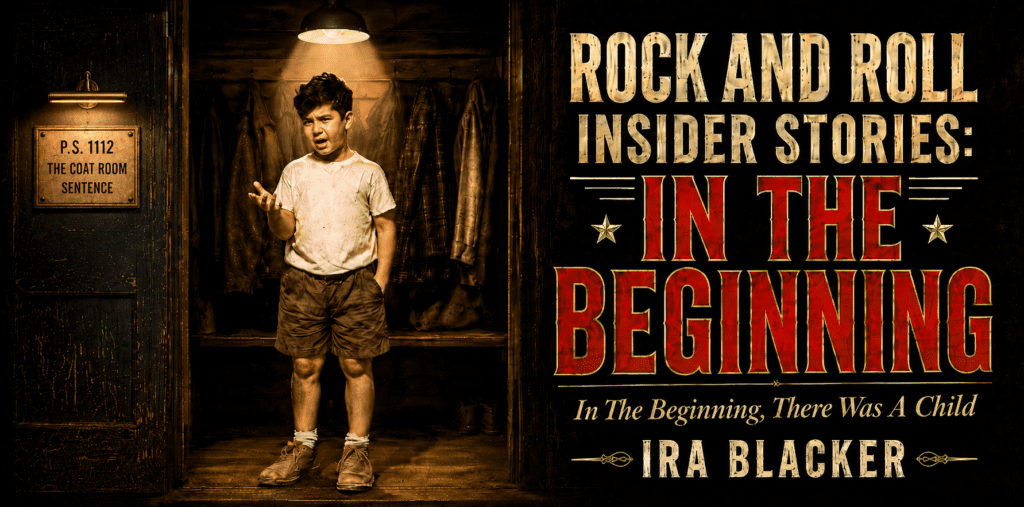
My second-grade teacher had a solution for my disruptive behavior. She put me in the closet with all the children’s winter coats. This was meant to remove me from the classroom environment. Naturally, I found it less boring than the classroom and turned it into my first attempt at stand-up comedy, although there were no chairs in the closet, so perhaps it was literally stand-up.
I made strange sounds, told children’s jokes, and probably created more commotion in the closet than I had in class. That led to my removal from the so-called early studies program and sent me further down the road toward Kings County.
Here is where stories from my life begin to show the pattern. When hurt, I acted out. When ignored, I made noise. When punished, I became funnier or angrier, depending on the available audience. Years later, inside the music business, that same wiring would help me survive rooms full of egos, hustlers, artists, managers, and professional smile artists. But in the beginning, it was just a child trying not to disappear.
The Lessons Were Beaten In Early
Some of my earliest lessons were delivered by my father with his hands. Once, when he played with me during one of those rare fatherly moments, his glasses fell and broke. It was his accident, not mine, but he beat me until the rage emptied itself onto my little frame.
The worst beating took place during a rare family vacation at a dumpy resort in upstate New York. There were separate shower areas for men and women, and since my mother entered the women’s side, I was trapped with my father in the men’s. I suppose my fear followed me into that shower, and perhaps he could smell it, because it may have reminded him of his own fear as a child. He did not like that.
There is nothing quite like being struck by an adult as hard as he can hit you when you are naked and soaking wet. That gave new meaning to the word pain, and it introduced me to degradation long before I could spell it.
That is why this belongs among rock and roll insider stories. Not because it is glamorous, but because it explains the engine. The later adult did not chase applause only because applause was pleasant. He chased it because silence had once been unbearable.
The First Stop On The Misery Train
Eventually, my behavior became more disruptive, and my anxious tics arrived, including licking my lips until they festered and scabbed. I was a five-year-old mess, which was apparently not seen as the result of a household in distress but as proof that I was the problem.

So, when I reached the ripe old age of six, I was sent away. The first stop on the misery train was Kings County Hospital, Mental Ward, where the rocket scientist doctors diagnosed me as autistic. They were wrong, of course, but there I was, living in the bug factory, a place no child should have had to experience as part of his early education.
My parents could not be to blame, or so the family logic seemed to go. Therefore, the kid had to be shunted aside, evaluated, labeled, and removed. That is how my story my life began to take shape: not as a neat little tale of early promise, but as a survival story with bad lighting and worse judgment.
From Brooklyn Damage To Rock And Roll
When people read classic rock memoirs, music industry stories, new rock memoirs, a rock and roll autobiography, rock memoirs, or rock n roll memoirs, they often expect the beginning to start with the first record, the first concert, or the first famous name. I understand the appeal. It is more fun to begin with the amplifier already humming.
But the real beginning came earlier. It came in the apartment, the schoolroom, the closet, the shower, the hospital ward, and the strange little spaces where fear and fantasy learned to live together. It came before I knew the names of the most influential people in rock and roll, before I had any idea that music would become an escape, an identity, and eventually a career.
These rock and roll insider stories begin with the child who did not yet know he would one day find rhythm and blues on a Brooklyn rooftop, much less walk into the music business and make his living around artists, agents, managers, and promoters. The child only knew that life hurt, adults could not always be trusted, and fantasy was sometimes the only place where he had power.
That is not a detour from the rock and roll story. That is the root system under it.
Why The Beginning Matters
If there is a legend here, it was not born under stage lights. It was born in damage, fear, humiliation, rage, humor, and the desperate need to matter. Later, rock and roll would give that need a beat, a business card, a backstage pass, and a battlefield. But before any of that, there was a little boy trying to understand why the people who were supposed to protect him could also terrify him.
So when I write rock and roll insider stories, I am not writing from the fan section. I am writing from the inside of a life that started long before the music business, and in many ways explains why the music business made such strange sense to me. It was loud, unfair, exciting, dangerous, funny, seductive, and unpredictable.
In other words, compared to my childhood, it felt strangely familiar.
That is why rock and roll insider stories must begin in the beginning. Not because childhood is cute, but because childhood is evidence. The man who later walked into the storm of rock and roll had already been through weather. He had already learned how to duck, joke, rage, charm, escape, and survive.
The best rock and roll insider stories do not begin with the reader already in the greenroom. They begin with the making of the person who would one day get there. Mine begin with the boy who was afraid, angry, funny, wounded, and still somehow alive enough to keep reaching for sound, rhythm, escape, and one clear reason to believe he mattered.
That is why these rock and roll insider stories are not only about the music business. They are about the machinery inside the man who entered it.
The music came later. The insider was born first.
