








A Rock And Roll True Story From The Other Side Of The Stage
A rock and roll true story depends on where you were standing. If you were in the audience, you saw the lights come down, the band walk onstage, the first chord hit, and several thousand people lose their minds. I saw that too, but I was usually looking at something else: the promoter, the building, the ticket demand, the money, the manager, the next city, and the problem nobody in the audience knew existed.
That difference is at the center of every rock and roll true story I tell. The audience saw the finished product. I saw the machinery that put it there.
Rock And Roll True Story: The Audience Saw Rod Stewart And Faces. I Saw The Strategy
When Rod Stewart and Faces were beginning to build in America, the public saw a band exploding in front of them. What they did not see was the planning behind that explosion. A rock and roll true story is rarely as simple as a band becoming popular because people suddenly discovered them.
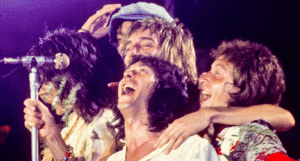
At American Talent International, we packaged Rod Stewart and Faces with Savoy Brown and The Grease Band, three recognizable acts that together could function as a headliner. Later, when a Boston promoter wanted Rod Stewart and Faces in the 20,000-seat Garden, I put them in the roughly 4,400-seat Boston Music Hall instead. Fans who could not get in crowded the streets and even scaled the building looking for a way inside. The audience saw hysteria. I saw demand being created.
That is the part of a rock and roll story that usually disappears when history gets retold. The lights, the music and the cheering survive. The decision that helped make those things happen does not. Those are the rock and roll true stories from the business side.
ROCK AND ROLL TRUE STORY: URIAH HEEP ALMOST NEVER LEFT THE AIRPORT
The audience saw Uriah Heep arrive in America ready to tour. What they did not see was the game of chicken taking place at Kennedy Airport. That is what makes this a rock and roll true story rather than simply another concert memory. I had already made a three-year agreement with their manager, Jerry Bron, but right up until the band arrived in America, he was still playing games about signing the written contract.
I was responsible for arranging the H1 visas for the British groups coming through ATI, so I finally decided enough was enough. I sent one of my agents to Kennedy Airport with the visas, the contract, and very simple instructions. Jerry could honor the agreement we had already made, sign the papers, and the group could begin its American tour. Otherwise, they could get back on the next plane to London.
The contract was signed and the tour went forward. To the people buying tickets, nothing unusual had happened. Uriah Heep simply showed up and played. To me, it was another rock and roll true story about the business that had to happen before the band could ever walk onto the stage.
Rock And Roll True Story: The Audience Saw Deep Purple. I Saw Betrayal.
Not every danger in rock and roll stood at the edge of a stage holding a knife. Some sat behind a desk wearing a business suit.
Deep Purple had become one of ATI’s biggest attractions. What the fans saw was a major rock band moving through the height of its career. What I saw one day was Bruce Payne, an agent I had hired and considered a friend, resign from ATI to start his own agency with the backing of Deep Purple’s management and take the band with him.
There were no flashing lights, screaming crowds or encores. There was simply the realization that one of our largest acts was leaving with someone I trusted. To me, it felt like a death in the family or a divorce. That is also a rock and roll true story, because the business was filled with friendships, loyalties, ambitions and betrayals that never appeared on an album cover.
These were rock and roll stories the ticket buyer could never see.
ROCK AND ROLL TRUE STORY: THE SHOW STARTED LONG BEFORE THE LIGHTS WENT DOWN
That is the part of a rock and roll true story the audience rarely gets to see. By the time the lights went down and the first chord was played, much of the real work had already happened. Somebody had chosen the building, built the package, negotiated the deal, created the demand, fought over the contract, or made a decision that could change a career.
With Rod Stewart and Faces, the audience saw a band becoming a sensation while I saw the strategy helping make it happen. With Uriah Heep, they saw another British rock band beginning an American tour while I knew that, hours earlier, the entire thing still depended on a signature at Kennedy Airport. With Deep Purple, the public saw one of the biggest rock attractions in the world while I learned one of the most expensive lessons of my career about protecting relationships I had built.
The musicians made the music and earned the applause. My world was everything that had to happen before the audience ever heard the first note. That is where many of my rock and roll stories began, and why every rock and roll true story looks different when you tell it from the other side of the stage.
