









When Music Industry True Stories Collide With The Legend
I was on one of the top-rated music forums when a post I had started was closed. A member still had a solid and cogent question—one that had not been asked before the thread ended—so he started a second post and presented the question again. His question was simple: “Is this a photo of the industry professionals meeting that Bill Graham discussed in his memoir?” He then posted a lengthy excerpt from Graham’s memoir explaining Bill’s version of what had happened at that meeting.
That exchange reminded me why I continue writing music industry true stories. The longer history sits around, the easier it becomes for legend, self-promotion, selective memory, and plain old B. S. to replace what actually happened. Eventually, somebody searches for the story and discovers that people who were really in the room have become footnotes, while others who were not have somehow become the heroes. And I see this in music forums all the time, where the fans and wannabe’s come across as experts when they were not there and haven’t the foggiest notion of the “real deal Neal.”
For anyone who wants the complete context, including the original forum question, Bill Graham’s account, and my full reply, you can read the complete exchange here.
When The Internet Starts Rewriting Rock And Roll History
For some reason, American Talent International never had as much Google search coverage as my own name. As I began searching online for who did what and when, I started finding other people taking credit for things I had actually accomplished. That was one of the stranger discoveries that came from researching my own past. I had lived the events, worked the deals, sat in the rooms and made the calls, yet decades later I could search for those same events and find somebody else’s version staring back at me. That is one of the problems with rock and roll history. Repeat something enough times online and repetition can begin masquerading as fact.
One of the most glaring examples involved Rush. I wrote an entire chapter in Once A King, Now A Prince about how I broke Rush in America, taking them from a bar band into the big leagues in one of the quickest ascents up the music ladder I had ever seen. Later I wrote a post laying out the story and the methods behind it. The deal was something Irv Steinberg, president of Mercury Records, and I concocted. Yet years later I found secondary players taking credit for it, along with radio people described on Wikipedia and elsewhere in ways that made it sound as though because they were among the first people to play Rush, they were the people who broke Rush. They did not!
Being the first person to play a record can be important, but breaking an act nationally is an entirely different animal. It involves records, agents, promoters, routing, guarantees, radio, timing, strategy, persistence and getting all those moving parts to work together before the opportunity disappears. That distinction becomes particularly important when someone searches for music industry true stories years later and assumes whatever appears first on a screen must be the whole story.
Bill Graham Tells His Side
The forum member had quoted Graham explaining that he had handled several major national tours directly and bypassed the traditional agency system. In this instance, Graham said, “We were not agents, and we did not use agents to do the work.” He also described what followed as “a showdown with the agents and managers on Long Island,” and later portrayed the meeting as one where agents, managers and promoters had gathered because of what he had been doing with national tours. That was enough context for me. I knew the meeting, I knew Bill, and I knew the business in which all of this supposedly occurred.
The real Bill Graham, whom I knew well, and to my recollection, never said much about agents at the event being discussed on the forum. The only two agents I heard, secondhand, that he ever referred to were Frank Barsalona and me.
Bill Graham, Frank Barsalona And A Hamburger
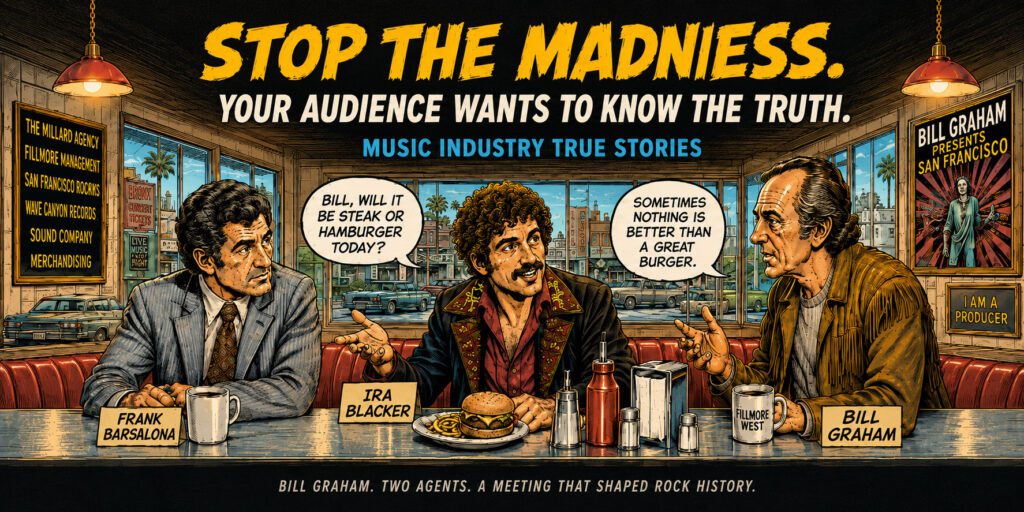
Bill compared Frank, longer in the business than I was, as his favorite between us. He stated, per Sepp Donahower, that I was “like eating hamburger,” and Frank was “like eating steak.” Sepp, who bought from us both, told Bill that “sometimes nothing is better than a great burger.” Frank and I, in an even split, represented almost the entire rock flock between us. The difference was that my bands made money on first tours; his did not. The reason for that was because I worked harder and plugged in those Monday, Tuesday and Wednesday gigs. That was how I was able to guarantee Rod Stewart and Faces that their tour would not go into the red and that it would go into the history books.
A hamburger-and-steak story sounds like nothing more than funny music-business gossip until you understand what sat underneath it: two agents representing an enormous portion of the rock business, two approaches to developing artists, and promoters like Bill Graham dealing with both of us. Those are the details that disappear when music industry true stories are reduced to a paragraph written decades later by somebody trying to remember—or improve—his place in history.
The Wild West Had Some People Wearing Different Hats
There were only two agents, if I recall, in the photo of the meeting: Frank Barsalona and me, with Frank next to me. No managers, that I recall, were present, despite Bill saying there were. This was a meeting of promoters and agents to discuss the entire industry, well beyond the scope of what do we do with the egomaniac from San Francisco.
Bill, known to be a self-serving dog, also owned his own booking agency, The Millard Agency, and management company, Fillmore Management. He owned two record companies, San Francisco Records and Wolfgang Records, in addition to recording thousands of hours of music at the Fillmores, and you can imagine the sort of leveraging behind that. I might also add that he owned a sound company and merchandising company, and did I fail to mention the soul of many artists? So when he said it was the Wild West, with no rules, he meant that as a breaker of rules. Bill was a manager, agent and promoter—or, as he demanded to be called, a “producer.” LOL.
That is another problem with the way rock and roll history gets polished over time. Everybody remembers the famous promoter, the famous venue and the famous band, while what gets lost are the conflicts of interest, the leverage, the competing businesses, the negotiations and the people on every side of the desk who actually made the machinery work. The music business was never only about the music. There was a business operating behind every spotlight.
What Music Memoirs Remember And What They Forget
Bill’s version apparently made great reading in his “memoir.” I did not read it, but if that bull was the tone of the book, it only reinforces what the content of my memoir, my posts and my marketing have always been about. My memoir started as a journal, and when you keep a journal, YOU DON’T LIE TO YOURSELF. Fifteen years later, it morphed into a memoir, WARTS AND ALL, as one friend after another whom I let read it was let into my mind. The first encouragement came from a girlfriend with whom I was in an intimate relationship, and after she pointed out that it was written quite well, I included some close friends.
There is a considerable difference between recording your life when you do not know anybody else will ever read it and reconstructing that life years later for an audience. That distinction is something I think about when reading music memoirs. Are we reading what happened, what somebody remembers happened, what they wish had happened—or the version that makes the best story forty years later? None of us has perfect memory. I certainly don’t claim to. But there is a big difference between saying, “This is what I remember,” and allowing a good story to become accepted rock and roll history simply because the other people in the room are no longer speaking up.
When Everybody Becomes The Person Who Broke The Band
The Internet has given the old music business something we never had while we were living it: a permanent scoreboard showing who supposedly deserves credit. The problem is that much of that scoreboard was filled in decades after the game ended.
Someone gives an interview, somebody writes an article, another website repeats it, Wikipedia picks it up, and search engines find the repetitions until repetition itself starts looking like documentation. That was exactly what I discovered when researching Rush. People who played a role deserved credit for that role, but what I object to is when a supporting role somehow turns into the starring role. There is enough genuine glory in the music business without borrowing somebody else’s.
This is where music industry true stories serve another purpose. They allow people who actually participated in events to put their recollections on the record while they still can, giving readers the opportunity to compare versions, weigh the evidence and decide for themselves.
Why Rock And Roll Autobiographies Need The People Who Were There
The best rock and roll autobiographies offer something an encyclopedia entry or retrospective article can never completely duplicate: the voice of a witness. Not an historian reconstructing the scene, a fan assembling old clippings, or somebody repeating what somebody else said somebody did, but someone who was actually there. That doesn’t automatically make every recollection correct. Memory can fade, dates can blur and two people in the same room can remember the same event differently, but firsthand testimony at least tells you where the information came from.
That is far different from the fan or wannabe expert announcing how something “really happened” when he wasn’t there and doesn’t know the people involved. When enough of those claims accumulate, they begin changing the public version of rock and roll history.
My Rock & Roll Book Was Never A Press Release
Once A King, Now A Prince did not begin as a marketing project. It began as a journal. That may be why my rock & roll book doesn’t behave like a press release. It refuses to protect everybody—including me. There are triumphs in it, failures, people I loved, people I fought with, people I helped, people who helped me, and things I would handle differently if some impossible machine deposited me back into those years. But rewriting those events to make myself look better would defeat the reason I wrote them down in the first place. This is the only way to write music industry true stories.
The same problem exists across music memoirs and rock and roll autobiographies. There is always a temptation to polish the furniture before inviting the reader into the room. My preference was to leave some of the broken chairs exactly where they were.
Music Industry True Stories Versus The Search Engine
There is some irony in the fact that search engines helped me discover how much of my own history had become distorted, while those same search engines now give me a way to put my firsthand version into the record.
I cannot control what someone writes on Wikipedia, what another person claims in an interview, or what a fan on a music forum decides happened twenty or thirty years before he ever heard the story. What I can do is continue telling music industry true stories with names, circumstances and context, and let readers compare them with the other versions floating around online. That is what I did when I wrote about Rush, and that is what I did when BlueTrane asked me about Bill Graham and that Long Island meeting. I will continue doing it whenever some piece of rock and roll history crosses my screen looking suspiciously different from the one I actually lived.
Because the further we get from the events, the fewer firsthand witnesses remain. Legends get larger, stories get cleaner, and B. S. gets repeated until somebody mistakes it for fact. Sometimes all it takes to blow that away is one of the people who was actually there telling one more music industry true story—but unfortunately too many of those people are no longer alive.
STOP THE MADNESS. Your audience wants to know the truth.
Music Industry True Stories can be rough to write sometimes, so I needed some fun after writing this bit of rock and roll history, to lighten up my mood by creating a fun book trailer, and it hopefully puts a smile on your face.
