









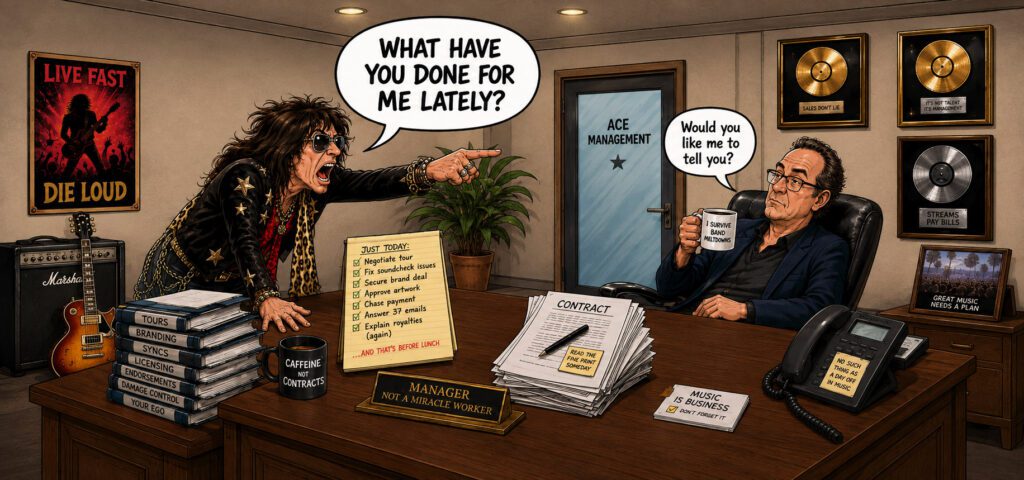
The Music Is Only Half the Job
Someone remarked to me recently about how hard it is to succeed in the music business. I had originally answered him online, but the more I thought about my reply, the more I realized I had reduced a lifetime of experience to a few paragraphs. There was a larger music business story sitting underneath it, because when people talk about “the music business,” they sometimes hear only the first word. Music is what brings everyone into the room. Business is what keeps the lights on, gets the record heard, puts the artist on the road, pays the bills, and gives a career a chance to last beyond one lucky break.
That does not mean an artist has to become an accountant with a guitar. It does mean that anyone who wants to make a living from music eventually has to understand that he has entered two professions at once. One is creative and emotional. The other runs on contracts, money, timing, leverage, relationships, and the ability to recognize an opportunity before it disappears. I have always thought that was one of the hardest truths for artists to accept, because the music may be personal, but the career surrounding it is still a business.
I spent much of my adult life on that other side of the desk. As an agent, manager, publisher, and music industry executive, I could love the music and still have to ask what it cost to put the act on the road, who was going to promote it, whether radio would play it, whether a record company believed in it, and whether the people around the artist knew how to turn attention into a career. Those questions were not an insult to the music. They were part of protecting it.
The Business Changes, but the Problem Does Not
Music comes in cycles. This week it is salami for lunch and next week everybody wants hamburgers. The public changes its taste, a new sound comes along, the old experts announce that it will never last, and six months later half of them are claiming they discovered it. The business surrounding music changes just as quickly. When I was a kid, guys sold records out of the trunks of their cars, and no, they were not stolen. By the sixties, the industry had become much more organized, with record companies, agencies, managers, publishers, promoters, radio people, distributors, and all the other machinery that could take an unknown act and help turn it into something much larger.
Then the machinery changed again. Napster came along and the record business fell on its ass. Eventually it got up, brushed off its pants, and reorganized itself around downloading, streaming, touring, merchandise, licensing, and deals in which labels increasingly wanted a piece of nearly everything an artist could earn. Tomorrow it will be something else. That is one reason I enjoy music business true stories more than theories about how the industry is supposed to work. Theories stay neat. The business never does.
A music business story I like to tell begins with a simple fact: the public usually sees the show, while the business people see everything required to make the show possible. Fans see the artist walk onto the stage. The agent sees the routing, the promoter, the guarantee, the hall, the advertising, the billing, the transportation, and the nights that have to work financially so the tour can continue. The manager sees the larger picture, including the record company, publishing, publicity, money, personalities, and the constant question of what comes next. The artist may not want to spend his life worrying about those things, and frankly I do not blame him. But somebody had better.
That was certainly true during my years as owner of American Talent International. I was around artists who had the talent, songs, stage presence, and ambition to become important, but those things still had to be connected to an audience. Rush is an obvious example from my own life. I heard the record, signed the band through ATI, and helped push the opportunity in America. The music had to be there first, but the music sitting by itself could not book a tour, make the calls, create leverage, or turn one opening into the next. That is not taking anything away from an artist. It is simply acknowledging that careers are built by a combination of talent and people who know what to do with it.
Artists, Managers, and the Fear of Getting Screwed
This is where another music business story begins, because artists have always had good reason to be suspicious. The history of the business is full of terrible contracts, missing money, managers who managed themselves better than their clients, and record companies that could find twelve ways to deduct a dollar before an artist ever saw it. I understood the paranoia then and I understand it now. What I do not believe is that fear should prevent an artist from making a serious commitment to somebody capable of helping him.
If you do not want to learn the business yourself, find an experienced manager you can trust and be comfortable with. He should have business ability, but I also believe he needs ears. He has to understand what makes the artist special, know the people who can move a career forward, and be willing to live with the daily aggravation that comes with representing another human being’s ambitions. A manager who understands contracts but does not understand music is missing half the job. A manager who loves your songs but cannot negotiate, organize, sell, or make a difficult call is missing the other half.
Do not let paranoia bite you on the ass and stop you from making a long-term agreement merely because “long term” sounds frightening. Protect yourself intelligently instead. Sit down with competent advice, decide what you believe reasonable performance should look like, and build measurable expectations into the agreement. A record deal, agency relationship, publishing agreement, income level, or another meaningful milestone can be tied to a period of time. If the person representing you does not perform, there can be a way out. That is not distrust. That is business, and good business can protect both sides.
I have seen relationships fail because one side believed a handshake meant eternal loyalty while the other side believed it meant lunch. Clear expectations are healthier. The artist should know what the manager is supposed to do, and the manager should know what the artist is prepared to do. Nobody can guarantee a hit record or a sold-out arena, but people can be held accountable for effort, access, follow-through, honesty, and the things they actually control. That is the less glamorous part of any music business book, but it is also the part that keeps the glamorous moments from becoming expensive accidents.
“If a Tree Falls in the Forest” Is Also A Music Business Story
A music business story I have always liked to use with artists is the old question about the tree falling in the forest. If a tree falls and nobody is there to hear it, did it make a sound? I would change the question slightly: if you make wonderful music and nobody ever hears it, what exactly have you built?
You can write the greatest song in the world, sing your ass off, become a magnificent musician, and make a record that deserves to be heard. None of those things automatically creates an audience. Somebody still has to get the music to radio, streaming, press, promoters, clubs, agents, record companies, or whatever set of gatekeepers and pathways exists at that particular moment. Somebody has to create the first opportunity and then turn it into the second. The business cannot manufacture genuine talent, but talent cannot conduct all of its business by magic.
That is why I never accepted the idea that the “business guys” were automatically the enemy of the artist. Some certainly were. I met crooks, phonies, incompetents, and people whose love of music ended exactly where their percentage began. I also met men and women who were in the business because they genuinely loved music and found that their own talent was helping somebody else’s talent reach the public. I was one of those people. I was not standing behind a microphone, but I was still participating in the music.
My music autobiography, Once A King, Now A Prince, naturally contains artists and famous names, but much of the real story is about that machinery behind them. I was fascinated by the point where instinct met commerce: hearing something, believing in it, and then trying to persuade everybody else that they should believe in it too. That is also why so many music business true stories are really stories about judgment. Sometimes you hear it before everyone else. Sometimes everyone else hears it before you.
Barry, Gary, and the Music We Did Not Understand
One of my favorite examples is a music business story about my late friend Barry “Reazar” Richards and his son Gary Richards, better known as Destructo. Barry and I were song guys. He came from radio and later became a hell of an independent record promotion man. I came from agency, management, and publishing. Between the two of us, we thought our ears were fairly well educated.
Then Gary got heavily into rave music, and I could not understand what the hell anybody heard in it. Barry could not either. We came from songs, melodies, hooks, verses, choruses, and records that moved in a way our ears understood. Rave, trance, and the electronic music Gary loved seemed to us like something from another planet, and Barry and I laughed about it.
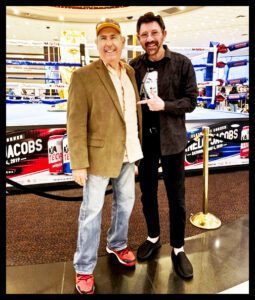
Then Barry went to one of Gary’s first raves and saw thousands of young people dancing to the music we had dismissed. That changed the conversation. Barry may not have understood the music when he walked in, but he understood the audience before he walked out. I did too. Barry also ran the water concession and made out like a bandit, which I am sure did nothing to weaken his conversion.
Gary went on to build a substantial career as Destructo, and the lesson stayed with me. Experience gives you perspective; it does not give you ownership of the future. One of the most dangerous things a music industry executive can say is, “I don’t like it, therefore nobody else will.” The public does not ask permission from yesterday’s experts before deciding what it wants tomorrow.
That is what makes this particular music business story useful to me. Barry and I were not fools. We had spent years listening to records and watching audiences. Yet a younger generation heard something we did not hear, and the smart move was not to defend our expertise until death. The smart move was to look at those thousands of people dancing and admit that maybe the kids knew something.
I Could Not Play, So I Found Another Instrument: The Telephone
There was another reason Barry and I understood each other. Both of us loved music, but neither of us needed to be the man standing at center stage to prove it. Many people entered the music business for money, fame, women, drugs, access, or whatever fantasy they thought might be waiting backstage. Plenty of them existed, and I knew my share. But there were also people who simply loved music and found a way to make that love useful.
I would have loved to have been a musician. The only problem was that I was a crappy one. I could not play my horn for shit. So, eventually, I stopped trying to make a living tooting the horn and found out I was much better at tooting my horn for other people.
Agency, management, publishing, promotion, negotiation, spotting talent, and putting people together became my instruments. I still needed ears and a creative side, but I used them differently. I could listen to an artist and imagine where the opportunity might be. I could hear a record and think about who needed to hear it next. I could look at a tour and see how acts might fit together. That was creativity too, only nobody applauded when you finished the phone call.
That point runs through my music business book because it is impossible to separate the artists from the people who helped create the circumstances around them. A career is not a solo performance, even when only one name is printed on the ticket. Behind most lasting artists is a collection of people who believed, argued, negotiated, promoted, booked, worried, and occasionally performed a small miracle before lunch.
The Other Side of the Desk
If there is one music business story behind all the others, it is that music and business do not have to be enemies. The best people I knew understood that one existed to serve the other. Without worthwhile music, there was nothing to sell. Without a functioning business around it, worthwhile music could remain unheard, underpaid, or gone before it had a chance to find its audience.
That does not mean artists should surrender control or trust everybody wearing a suit. They should learn enough to ask intelligent questions, surround themselves with people who know more than they do in the areas that matter, and never confuse cynicism with sophistication. Getting screwed once does not mean every manager is a thief. Making one bad deal does not mean every contract is a trap. It means you learn, protect yourself better, and keep going.
From my side of the desk, I saw the arguments, the egos, the fear, the ambition, the money, and the strange mixture of art and commerce that made the whole thing work when it worked. I also saw enough failure to know that no formula guarantees anything. That is why I prefer music business true stories to tidy lessons. Real careers are messy. People make mistakes. Tastes change. Somebody misses the obvious hit, somebody else hears it, and suddenly the fellow who looked crazy on Monday is a genius by Friday.
That is also why I continue writing about the other side of the music desk. Once A King, Now A Prince is a music autobiography, but it is also the record of what I saw when the audience was looking toward the stage and I was looking at everything required to get the artist there. As a music industry executive, agent, manager, and publisher, I learned that loving music was never the opposite of understanding business. For me, understanding the business was one of the ways I served the music.
After all these years, that may be the simplest version of the music business story: make something worth hearing, then make damned sure somebody hears it.
