









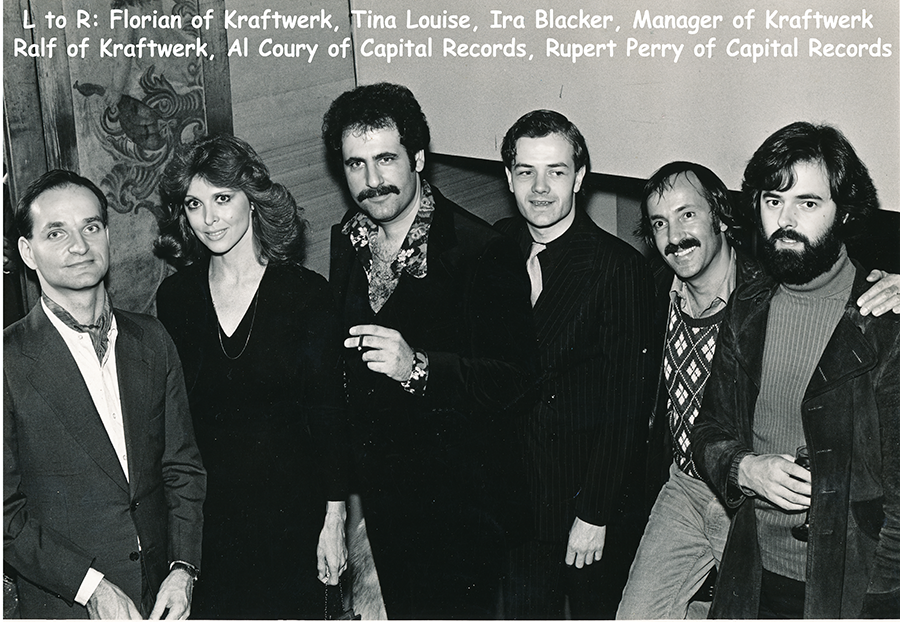
From left to right in the photo above, taken in the 70’s at the Capitol Records signing party for Kraftwerk, are Florian Schneider of Kraftwerk, my sister Tina, myself, Ralf Hutter of Kraftwerk, Al Coury and Rupert Perry of Capitol Records. My choice of Kraftwerk as the main photo here was “tongue-in-cheek.” As to sex, well, I was not aware of them being chased by the groupies.
——————————————————————————————————————–
There are phrases that feel less like words, and more like a backstage pass, and sex, drugs, rock and roll is one of them. It hums with distortion, sweat, neon lights, and the low thud of a bass line felt in the chest before it’s heard. For decades, this phrase has framed the public imagination of rock culture, shaping how fans understand the lives lived just beyond the stage lights.
What makes sex, drugs, rock and roll endure isn’t shock value. It’s honesty. It’s the refusal to polish the rough edges. Behind every sold-out arena and smashed guitar lived nights that blurred together, filled with adrenaline, indulgence, and an unspoken belief that tomorrow could wait.
This is why the best rock n roll book doesn’t sanitize. It documents the chaos with clarity, capturing what it meant to live inside the noise rather than merely listening from the crowd.
LIFE AFTER THE ENCORE
Once the amps cooled and the crowds spilled into the streets, the real theater often began. Hotel hallways turned into social crossroads. Dressing rooms became private worlds. Groupies weren’t caricatures; they were part of the ecosystem, drawn to the gravity of performers who seemed to live outside ordinary rules.
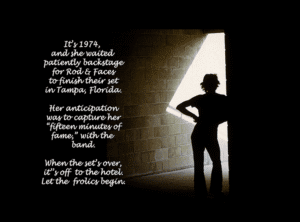
Within sex, drugs, rock and roll, intimacy wasn’t scheduled. It happened in fragments between soundchecks and sunrise. Sex parties were spoken about in hushed tones later, less for scandal and more for disbelief that such nights could exist at all. They weren’t choreographed fantasies, but spontaneous collisions of people chasing sensation and connection in a life that moved too fast for reflection.
Many rock n roll books revisit these scenes not to glorify them, but to explain the emotional velocity of that era. The closeness, the excess, the hunger to feel something real before the next city blurred into view.
THE CHEMISTRY OF ESCAPE
Drugs were never just props in sex, drugs, rock and roll. They were tools, crutches, and sometimes traps. From stimulants that kept bodies upright through endless tours to substances used to quiet the noise after the show, chemicals played different roles on different nights.
A serious rock n roll memoirs approach doesn’t rely on shock. It contextualizes. It explains why certain drugs circulated backstage and why others followed musicians home. Some were about stamina. Others were about silence. Many were about surviving an environment where normal rhythms of sleep, privacy, and grounding barely existed.
In the most compelling rock n roll book, these moments are described with reflection rather than bragging. The honesty lands harder when the narrator understands what those choices cost.
MUSIC AS THE CENTER OF THE STORM
Strip everything else away and sex, drugs, rock and roll always comes back to the music. The grind of rehearsal. The violence of volume. The precision hidden inside apparent chaos. Rock wasn’t just a soundtrack to excess; it was the reason excess gathered in the first place.
The best rock n roll books never lose sight of this. They describe how songs were born in exhaustion, how riffs emerged after nights that ran too long, how the roar of a crowd could feel like absolution. Without the music, the rest collapses into empty spectacle.
Many rock n roll memoirs reveal that what musicians chased wasn’t pleasure alone. It was transcendence. A moment on stage where everything aligned and the world briefly made sense.
WHY READERS STILL WANT THE TRUTH
Modern audiences aren’t naïve. They don’t need fairy tales. They want perspective. That’s why sex, drugs, rock and roll still sells books, fills documentaries, and fuels conversations. Readers want to know how it really felt to live without a safety net.
A well-written rock n roll book doesn’t just recount wild nights. It connects them to the cost-of-living loud. The relationships strained. The bodies worn down. The strange grief that followed the applause.
The strongest rock n roll memoirs understand that legacy matters more than legend. They don’t deny the excess. They frame it as part of a larger human story about ambition, appetite, and art.
THE LEGEND THAT WON’T DIE
Long after the lights go dark, sex, drugs, rock and roll remains shorthand for a moment in cultural history when restraint felt optional, and volume felt necessary. It survives because it was real, messy, and unscripted.
Every meaningful rock n roll books entry into this world respects that tension. The thrill and the fallout. The freedom and the price. It’s not nostalgia. It’s documentation.
And as long as people want to understand how music once rewired the rules of living, sex, drugs, rock and roll will keep echoing, loud and unapologetic.
My choice for the main photo here of Kraftwerk was “tongue-in-cheek.” As to sex, well, I was not aware of them being chased by the groupies.
“Sex & Drugs & Rock & Roll” is a phrase popularized by English singer Ian Dury in his 1977 single of the same name, encapsulating the hedonistic lifestyle often associated with rock music.
Ira Blacker reads the above blog post.
