









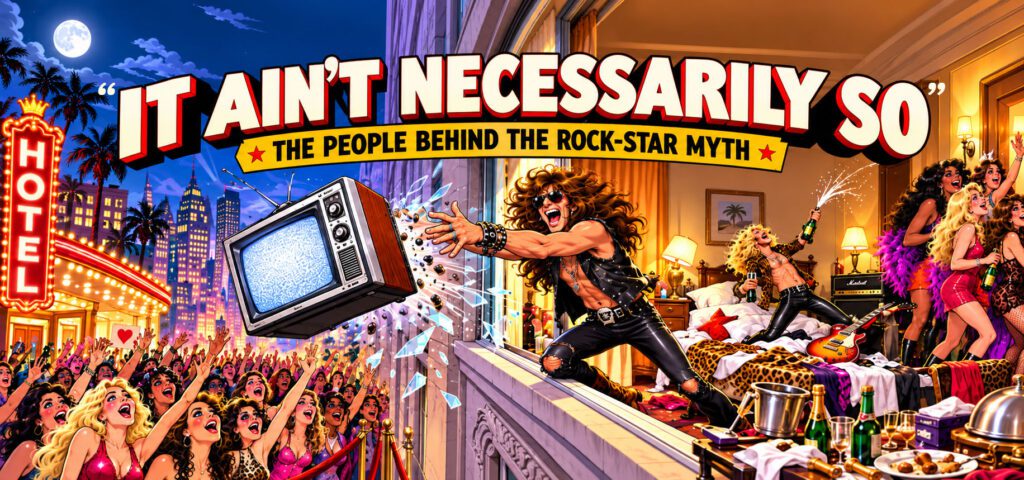
Rock Stars Weren’t Always What You Thought
When most people think about rock bands, the picture that comes to mind is usually the wild, crazy, drug-addicted rocker with very little humanity left once the stage lights go down. That image sells movies, magazines, and plenty of books. It also happens to be wrong much of the time. If a best music memoir is going to tell the truth about rock and roll, it has to include the people behind the mythology, not just the mythology itself.
I spent a large part of my life inside the music business, first as an agent and later as an owner of American Talent International. I saw plenty of behavior that lived up to the reputation of rock and roll, but I also saw something that rarely gets as much attention: kindness. Some of the people who looked the wildest from the outside were absolute gems to me.
You may say, “Well, you were a powerful music agent who they depended upon.” My answer is simple: that was then, this is now. Decades later, there was nothing left for them to gain from being kind to me, remembering me, or saying something generous about the way I treated them. Yet some of them did exactly that. Those are the stories I want in a best music memoir, because they tell you something the standard rock-and-roll caricature does not.
A best music memoir should not merely repeat the public image. It should show the human being who existed when the interview was over, the tour was finished, and nobody was asking for anything.
Roger Earl: And A Memory I Had Almost Forgotten
Roger Earl came into my life through Savoy Brown and later became known around the world as the drummer for Foghat. When I began asking former clients and people from my music-business years for testimonials for the back cover of Once A King, Now A Prince, I contacted quite a few people. Some responded. Some did not. Roger responded immediately.
What surprised me was not simply that he was willing to give me a testimonial. It was what he remembered. His comments brought back moments and details that I had long forgotten, and he spoke about me with a warmth I did not expect after all those years. He could have sent two polite sentences and moved on. Instead, he reminded me that relationships formed inside the music business were not always merely transactions between an artist and an agent.
That is one reason I resist the easy stereotype of musicians as self-absorbed people interested only in themselves. Roger had no business reason to make me feel good decades later. He simply did it. A real classic rock memoir should leave room for moments like that, because they reveal the character of the people involved better than another story about a trashed hotel room ever could.
For me, that is part of what makes a best music memoir worth reading. It is not only who was famous or what record sold. It is what people remembered about one another after the business itself was long gone.
Rory Gallagher: My First Guinness And A Real Friendship
Rory Gallagher was another one. Rory bought me my first pint of Guinness. It was warm, which was not exactly how I had imagined my introduction to Guinness, but I drank it. More important than the beer was the genuine affection Rory always showed me. He was one of the most polite and decent artists I ever worked with, and the warmth never felt calculated.
His brother and manager, Donal Gallagher, was cut from much the same cloth. Donal once gave me his apartment in London to stay in for a couple of weeks, free of charge. Years later, when I asked for a testimonial for the rear cover of my memoir, he gave me one. Again, there was no deal to close and no tour to book. There was only history.
People who read classic rock memoirs often come looking for larger-than-life stories, and I understand that. Rock and roll was larger than life. But some of the moments that stayed with me were quiet ones: a pint of Guinness, an apartment offered without hesitation, an old friend remembering what you meant to him. Leave those moments out and you may have a book about rock stars, but not necessarily the best music memoir you can write.
The best music memoir should preserve those small acts because they tell you what the headlines never could. Rory and Donal were part of a business built on money, dates, contracts, and touring, but what I remember most clearly now is the humanity.
Badfinger: Polite Men And A Terrible Ending
After Rory, Badfinger may have been the most polite bunch of guys I ever worked with. All of them. That is what I remember first, even before I think about the tragedy that later became inseparable from the band’s story. They were talented, courteous, and remarkably easy to deal with in a business where easy was not always the word that came to mind.
I have written separately about Badfinger and Stan Polley, and I do not need to repeat the entire story here. What happened around that band remains one of the ugliest examples of what could happen inside the music business when artists placed their careers and finances in the wrong hands. What Stan Polley did to them was, in my view, absolutely criminal. The point here is different: Badfinger themselves were not the stereotype. They were decent men caught in circumstances that became devastating.
That distinction matters in any classic rock memoir. The people onstage may be the ones the public sees, but managers, agents, accountants, record companies, promoters, lawyers, and others can shape a career just as dramatically as the music. Some of the darkest stories in best music memoirs are not about musicians behaving badly. They are about what happened to musicians when the business around them failed them.
A best music memoir has to make room for that side of the story. Otherwise, the reader gets the star but not the system surrounding the star, and sometimes that system is where the real story lives.
Mandrill: Beau Ray Fleming And The Other Side Of The Business
Mandrill was an R&B band rather than a hard-rock act, but they belong here for the same reason: decency. Beau Ray Fleming was the band’s original manager, co-producer, and creative collaborator. He co-produced and managed their self-titled debut album, recorded at Electric Lady Studios and released on Polydor Records, and helped develop the visual identity surrounding the band.
What I remember most, however, is the man. Beau was kind, considerate, polite, and simply pleasant to deal with. That may sound like a small thing until you have spent years inside the music business, where personalities could fill every room before the person even entered it. A manager who could be creative, effective, and still treat people well was someone you remembered.
A best music memoir should explain why certain people stayed in your memory long after the contracts, tours, and commissions disappeared. Beau Ray Fleming is one of those people for me.
That is also why a classic rock memoir or music-business memoir should not be built only around scandal. Sometimes the revealing story is that somebody treated people well in a world where that was not always guaranteed.
Ozzy Osbourne: Nothing Like The Character I Expected
Ozzy Osbourne may be the best example of why the title of this piece is “It Ain’t Necessarily So.” If there was ever a rock star whose public image encouraged you to expect one thing, it was Ozzy. His reputation preceded him by several miles. Yet my personal experience with him was almost the opposite of what someone might have expected.
I had booked his very first tour under his original manager, Pat Meehan, but the arrangement was pulled by Sharon Osbourne’s father, Don Arden. Arden managed major rock acts including Black Sabbath, Electric Light Orchestra, the Small Faces, and Little Richard. At the time, Ozzy knew who I was, but we had never really met.
That changed in the 1980s when I ran into Ozzy at a hotel just off the Champs-Élysées in Paris, where we both happened to be staying. We finally had the chance to spend real time together, not as two names attached to a tour or business deal, but as two people sitting and talking. We talked rock and roll, family, life, and all sorts of things.
He was genuinely nice to me. There was no reason for him to perform kindness, no deal pending and nothing I could do for him at that point. He was simply a pleasure to hang out with. I came away thinking that I was sorry we had never continued our business arrangement, because the man I spent time with in Paris was far removed from the cartoon version of Ozzy that many people carried around in their heads.
That encounter is exactly the sort of thing I want from a best music memoir. Everyone already knew the public Ozzy. What interested me was the private moment when the public character disappeared and I got to spend time with the person underneath it.
A best music memoir should give readers something they could not get from the public image alone. My memory of Ozzy does exactly that for me.
Not Everyone Answered The Call
I also reached out to Rod Stewart and Uriah Heep for comments for the back of Once A King, Now A Prince and never heard back. I am not turning that into a grievance; decades had passed. It simply made the generosity of people like Roger Earl and Donal Gallagher mean even more. The best music memoirs are built out of contrasts like that. Time has a way of showing you which relationships became more than business.
That contrast also belongs in a best music memoir because memory is not neat. Some people surprise you with kindness. Others disappear. Both are part of the truth.
What A Classic Rock Memoir Should Show
There are enough stories about excess in rock and roll to fill several libraries. I lived through some of them, and I have no intention of pretending the excess did not exist. Sex, drugs, ego, money, betrayal, and insanity were part of the world. But they were never the whole world.
A good classic rock memoir should show the contradictions. The outrageous performer can also be thoughtful. The supposedly dangerous rocker can be gentle. The manager working in a cutthroat business can be considerate. A band can be surrounded by chaos and still consist of polite, decent men. Human beings rarely remain inside the boxes we build for them.
That is why the most interesting stories inside the music business are not necessarily the ones everybody already knows. The public knows the album covers, scandals, arrests, divorces, and mythology. I knew some of these people when they were simply sitting in an office, riding in a car, eating dinner, having a drink, or trying to get through another day on the road.
For me, that is the difference between celebrity gossip and memoir. A best music memoir should not merely repeat the legend. It should complicate it.
The strongest classic rock memoirs do that by showing the contradictions, not sanding them away.
The People Behind The Records
The longer I am away from the music business, the more I find myself remembering people rather than deals. At the time, of course, the deal mattered. A tour had to be routed. A promoter had to be negotiated with. A guarantee had to make sense. An artist had to be placed in the right hall in the right city on the right night. That was the business I owned and lived.
What remains now is something else. I remember Roger’s kindness. I remember Rory and that first Guinness. I remember Donal’s generosity. I remember how polite the members of Badfinger were. I remember Beau Ray Fleming as a gentleman. I remember sitting in Paris with Ozzy Osbourne and discovering that the man in front of me was not the man the mythology had prepared me to meet.
Those memories are why Once A King, Now A Prince is not simply a collection of famous names. A best music memoir needs more than backstage access. Access gets you into the room. Memory, perspective, and honesty tell you what the room meant.
That is something the strongest classic rock memoirs understand. Readers may already know the records, tours, and headlines. What I can give them is the part I actually lived: the personalities as I encountered them, the relationships that lasted, the ones that did not, and the moments that never became part of the official story.
Inside The Music Business, Humanity Mattered
The music industry could be ruthless. I have written plenty about that. But if I wrote only about the ruthless people, I would be lying by omission. Some of the men and women I met inside the music business were loyal, funny, generous, thoughtful, and decent. Some became friends. Some disappeared for decades and then returned with a few words that meant more to me than they probably realized.
That is another reason the phrase best music memoir means something different to me than a list of the most outrageous stories. The best story is not always the craziest one. Sometimes it is the story that changes your opinion of someone and lets you see a famous person as a human being instead of a character.
A best music memoir should leave the reader with people, not just episodes. That is what these memories do for me.
Why “It Ain’t Necessarily So”
I chose that title because so much of what people think they know about rock and roll comes from repetition. An image gets marketed long enough and people begin to confuse it with the person.
My experience was different because I was there. I was not watching from the audience or reading the press release. I was representing artists, negotiating their tours, talking to their managers, spending time with them, and sometimes becoming their friend. I saw them when there was no spotlight on them.
If Once A King, Now A Prince belongs in the conversation about a best music memoir, it is because I have tried to preserve those contradictions. The book contains the madness because the madness happened. It contains betrayal because betrayal happened. But it also contains decency, loyalty, humor, affection, and the unexpected kindness of people the public may have assumed were incapable of any of those things.
That, to me, is what separates a real classic rock memoir from another collection of rock-and-roll legends. And it is what I look for in the best music memoirs: not perfection, not mythology, but the truth about the people who lived the life.
A best music memoir has to do more than name famous artists. It has to take the reader inside the music business and show what those people were actually like when the show was over. Roger Earl, Rory Gallagher, Badfinger, Beau Ray Fleming, and Ozzy Osbourne were very different people living in very different corners of the music world. What connects these memories is simple: each one reminded me that reputation is not character, and mythology is not necessarily truth.
That is why, after all these years, I still come back to the same conclusion: it ain’t necessarily so.
