








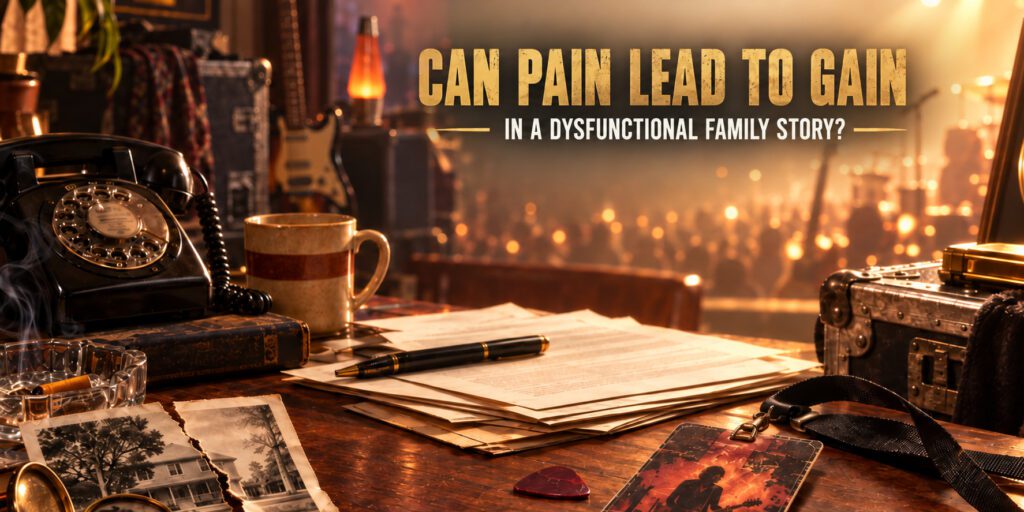
Well, I’ll tell you first that I am not a shrink, so I can only speak from firsthand experience, and that is my true life story. After years in the music business, I saw something that probably has shown up in other music business memoirs: many of the people I have come across in the music business were seemingly living their lives and ambitions as if they had their own dysfunctional family story to tell.
Many, it seemed to me, were driven by the need to overcompensate and “wet their beaks” in the talent pool. This goes for both artists and music business executives. Looking back, I can see how a dysfunctional family story can become a source of ambition as much as pain.
My Dysfunctional Family Story Of Survival
Maybe my fellow gym rats had a valid point that extended inside as well as outside the gym: there was “no gain without pain.” Another popular saying is that “what doesn’t kill you makes you stronger.” For myself, growing up to write about my own dysfunctional family story, I think both sayings may be true. Why? Because I survived my own dysfunctional family. For me, that dysfunctional family story became part of the fuel that kept pushing me forward.
I had a father who continually told me, in many ways, that I was not going to amount to anything, and treated me accordingly. As a child, when I was not beaten, I was ignored as if I didn’t exist. I have a sister, but the message there was that my father loved and wanted her, but not me. She was famous, and she also had her own dysfunctional family story to tell.
A classic case of my father trying to embed in me how useless I was occurred when I was 19. I would occasionally help him out in his luncheonette, and one day he asked me to sweep the floor. Within one minute, he grabbed the broom not just to show me “how it’s done,” but to complete the task himself. Another great life lesson in failure. That was another small chapter in my dysfunctional family story, but one that stayed with me for years.

I never thought about such connections at the time—how that type of treatment of me would mold my future life’s endeavors—but apparently those lessons did. I was a survivor. I wanted what my sister seemingly had, the love of a parent. In her case he abandoned her, and in mine, he both abused and abandoned me.
One day when I was about 22, I ran a dance in a large catering hall that was a huge success and wrote about it in my music business insider story about The Golden Slipper. When my father and mother showed up for the opening and saw the success, I saw him smile at me for the first time. In that moment, my dysfunctional family story suddenly seemed tied to achievement and the approval I had always wanted.
The message my father gave me at the time, with just that little bit of a smile, was enough to drive me forward in the same direction as my sister: if I became a celebrity, albeit in business, he would love and accept me. That little incident guided me in all I pursued thereafter in the music business as a lesson learned in my true life story. That dysfunctional family story had quietly become a driving force in my life and career.
This Music Business Insider Story Hurt
Throughout my life, as with all of us, there is some pain that is there along with the joys of life. This is something that lasts throughout one’s life. My true life story was no different. Even with the huge success of my life in the music business, there were moments of pain that felt no different from growing up with my early dysfunctional family story.
One such story in my life was the extreme loss of something that I helped build. When I signed Deep Purple to American Talent International, Ltd., the rock and roll agency that I owned and founded, they were well beyond their only hit in America, “Smoke On The Water.” Through some great and creative pairings on tour here, I helped establish them as an arena band, with one of their last performances booked by me at The California Jam in 1974, at the Ontario Speedway. Their payday was $400,000.00 for one performance. In today’s money, that would be $2,718,000.00.
Sometime after that, after he badgered me to death, I mistakenly allowed Bruce Payne to become their “responsible agent.” This meant that all bookings would be cleared by him and given to their management, Bob Cavallo and Joe Ruffallo, who also managed Earth Wind and Fire at that time. I also placed them on the same bill as Deep Purple to familiarize the white audience with their sound, heretofore appreciated mostly by those following R & B music. Bruce, like every agent who worked for me other than Bill Hall, who brought Z.Z. Top with him when hired, never had the ability to sign an act on his own.
Bruce paid me back by leaving ATI and taking Deep Purple with him. The pain was different, but it still touched the same nerve created by my dysfunctional family story.
Music Memoirs Cannot Be Only About The Writer
One of the most heartbreaking events that I watched unfold was with a young agent of mine, Bob Caviano. Bob was gay, but you would never know it and he never advertised it. He was athletic and played “hoops” with the heavy hitters down in the Village, on a court nicknamed “The Cage,” on W. 4th St. He roomed with another young agent I hired, Richard Halem.
One day Richard came to work ready to explode with his new knowledge about his roommate, Bob. He gleefully informed everyone that while searching under Bob’s mattress, he came across some gay porn magazines, thus confirming in his warped mind that his roomy was gay.
This, of course, was a cruel thing to do. Once the truth about his sexuality was exposed, Bob would often refer to his athletic prowess, which showed how masculine he was, and that he was not like the “ravers.” He now had one more thing in his life to prove: that he could still succeed, despite the cruel exposure of his roomy, Halem.
After Bob left ATI, he went on to become a very successful manager of artists such as Grace Jones, and solidified his success and accomplishments right up to his unfortunate death from AIDS. Watching that kind of pain in others also made me think about how a dysfunctional family story can leave someone with a lifelong need to prove himself.
Writing Music Memoirs Is Not An Easy Task
What makes writing music memoirs difficult is not the writing in general so much as writing music business memoirs and still being truthful to oneself and the reader. That means you would be telling the world about your pain, failures, and misdeeds, and bringing them out into the open so the reader can explore who you really are, see your soul and understand your music business insider story, sans the B.S., fabrications and mostly the omissions. It is these omissions, if included, that allow the reader to sense the whole story of not just what happened in your life, but how it affected you and drove you beyond survival.
My mother’s passing, when I was in my mid-thirties, was an especially difficult time. It occurred right after I moved to Los Angeles, because New York, to my mind, had less to offer me. That was truly a heart-blow and one of the most difficult times in my life, to the point of my flirting with suicide to stop the pain. While this was a tough admission to write about, my story can never be a true life story, nor can music memoirs be truly complete unless stories such as this are included. By then, I understood that surviving a dysfunctional family story did not mean the pain simply disappeared.
My mother’s death led me not just down the path I was on in rock and roll, but into the sex and drugs that went along with it. I did not withdraw from the music business, but once my sex, drugs and rock and roll lifestyle changed, I was too ashamed of my behavior to try to make deals at the top with my former peers, and I went down the ladder and only approached those well below them, those who, for the most part, could not make deals.
The Cruelty Of Others Can Hurt
Right after arriving in Los Angeles, I hooked up with my old partner from ATI, Sol Saffian. Sol was working for a company called World Wide Artists, which was owned by Sandy Smith, reputedly one of L.A.’s most notorious coke dealers, and Henry Lazerous, who made a fortune as a mobile carpet cleaner. One day, an agent at WWA, in a company meeting, when it came to the roles we should play in that business, referred to me in front of the others present as a “has-been.” His implication was that whatever the function was to be handled, he was more suited than I for it. That hurt.
That really hurt, but the truth has a way of waking you up. Fortunately for me, I went on to success in my management career after that. The agent who made that remark went nowhere.
Breaking The Pattern Of My Dysfunctional Family Story
After about a year and a half of “pure crazy” as a lifestyle—and thanks to my ability to survive, because you must survive to eventually thrive—I hit the gym, became what is called a gym rat for the remainder of my life, entered the world of martial arts, and, as they say, whoever they are, became “fit as a fiddle.” My endorphins were flowing and I rebuilt my career and became a personal manager to many chart artists, such as Kraftwerk, The Crusaders, Princess and others of that day. I survived and then thrived once again in the music business.
Life’s Continuing Lessons From Pain
As you grow older—and with me just turning 84—you do get to know pain. From a back worn from kicking, punching and running to a hand continually sore from decades of heavy bag, along with a brief stint of going blind, life still teaches you that pain is just a part of it. All you can do is try to overcome your dysfunctional family story and the other pains that come after it, survive them, learn from it all, and thrive.
