









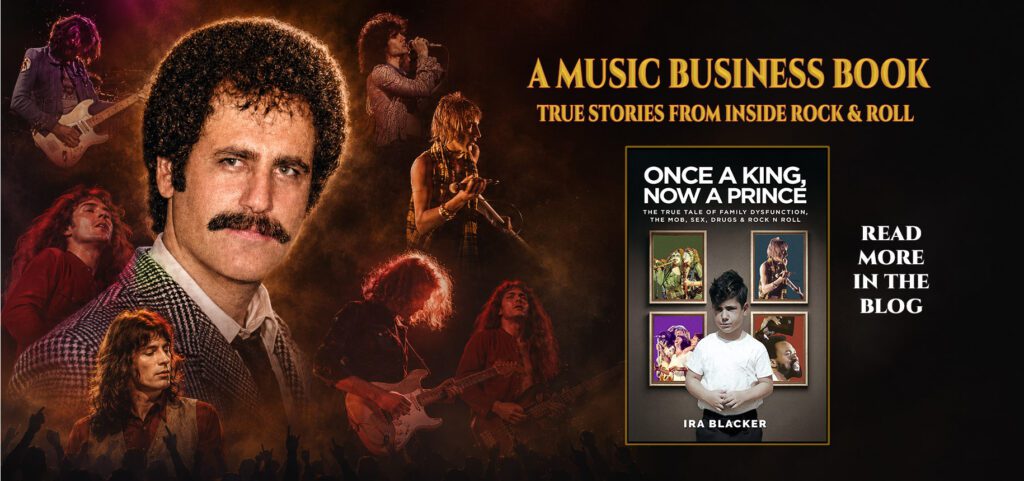
TRUE STORIES FROM INSIDE ROCK AND ROLL
A music business book should not read like a college course, a how-to manual, or some polished executive’s version of events after the lawyers have hosed down the floor. A real music business book should have blood in it, laughter in it, bad judgment in it, and enough truth to make the reader feel that somebody finally opened the back door and let him see what was really going on behind the stage, the contracts, the tours, and the deals.
Those are the kind of music business insider stories I wrote about in Once A King, Now A Prince. I did not come to the story as a critic sitting in a safe chair or as a fan guessing what might have happened from the balcony. I was inside it. I helped build American Talent Int. Ltd., a rock and roll agency that represented some of the biggest acts in the world, including Rod Stewart & Faces, Deep Purple, Nazareth, Uriah Heep, The Eagles, ZZ Top, and others. It was an extraordinary ride, and like many extraordinary rides, it did not end with everyone smiling and shaking hands.
Building American Talent And Walking Away From It

A music business book worth reading has to tell the business side of the story, not just the glamorous part. After founding and helping build American Talent Int. Ltd. into a real rock and roll force, I eventually walked out of the company I had helped create. That sounds simple enough when written in one sentence, but nothing about it was simple at the time.
My partners, Sol Saffian and Jeff Franklin, had each decided to represent an artist outside the agency, which I considered a direct conflict of interest. To me, that crossed a line.
I was still a young man, and while I had strong instincts, I did not always have the maturity to match them. Instead of calmly handling the situation like some gray-haired philosopher with a legal pad and a cup of tea, I went for the old “eye for an eye” approach. If they were going to manage artists apart from the agency, then I would manage one too. The difference was that my partners did not have my music ears. Whatever they signed for themselves never really made it. My signing was an unknown band from Toronto, Canada, called Rush.
The Rush Story Belongs In A Music Business Book
Rush had an album, but they could not get an American record deal. They were struggling to break through, and I believed they had something that others were missing. That is one reason this story belongs in a music business book. It was not only about hearing a band. It was about understanding how to create motion around a band before the industry believed there was motion.
I engineered a plan with the help of my friend Donna Halper, then music director at WMMS in Cleveland, and John Sher, who owned Gem Record Distribution in New Jersey and specialized in rock and roll imports by groups whose records had not been released on American labels. My plan was simple enough, and maybe a little too clever by half: John would tell record company executives, when they called, that the Rush import was blowing up and selling hand over fist.
Was that true? Not exactly. But how were they going to check it in five minutes from a desk in New York or Los Angeles? The music business was not always built on perfect information. Sometimes it was built on heat, perception, timing, and whether someone believed there was a train leaving the station and did not want to be the fool left standing on the platform.
How The Rush Record Deal Came Together
Donna had already been playing the Rush LP sporadically. After my call, when I told her about the supposed success of the import, that I was managing the band, and that I had also signed Rush to ATI and would put them on tour opening for other clients of mine, she bumped the record into rotation. That gave the band the radio life it needed, and I used all of that to help make a recording deal with Irwin Steinberg at Mercury Records.
Over the years, Wikipedia and other written pieces have given Mike Gormley and Cliff Burnstein credit for this, but that is not the case. The deal was with Irwin Steinberg, President of Mercury Records. That distinction matters because music insider stories are not always the stories that get repeated. Sometimes the version that survives is the one written later by people who were not standing in the room when the thing actually happened.
That is why a music business book written from firsthand experience matters. It may not always be neat, and memory may not arrive wearing a pressed suit, but when you were there, when you made the calls, when you heard the band, when you knew who said yes and who did not, you do not forget the shape of the event. You may forget lunch. You do not forget the deal.
Music Business True Stories Are Not Always Neat

The trouble with music business true stories is that they rarely arrive with clean edges. In public, the business likes to make everything look smoother than it was. A band gets discovered. A record company signs them. The album comes out. The fans arrive. The story becomes mythology. That is not how I remember it.
I remember calls, angles, favors, belief, timing, bluffing, instinct, and the ability to hear something before the accountants heard anything at all. I remember how artists could be ignored one month and chased the next. I remember how quickly people wanted to be attached to success once success became visible. The music business had a habit of developing amnesia the moment money entered the room.
That is why this music business book does not simply celebrate the winners after the parade has already started. It shows the machinery before the parade, when everyone was guessing, hustling, arguing, doubting, pushing, and trying to make the impossible look inevitable.
After ATI: Management, Tours, And Recording Deals
After leaving ATI and signing Rush, I formed a management company and signed artists including Kraftwerk, Brainstorm, Ronnie Laws, The Jazz Crusaders, Princess, and several German bands. That period of my life took me deeper into management, touring, and record deals. I arranged tours, created recording opportunities, and helped move acts through the strange tunnels of the music world, where talent alone was never enough and timing often mattered more than justice.
Kraftwerk was one of the more unusual and important acts I worked with. They were not simply another band trying to sound like everyone else. They had their own world, their own sound, and their own kind of discipline. That made them different, and different can be either a blessing or a curse in the music business, depending on who is listening and whether the room is ready for what it is hearing.
The Jazz Crusaders, Ronnie Laws, Princess, and the German bands each represented a different side of the business. Some stories were about tours. Some were about records. Some were about trying to persuade people that what I heard had value before the industry caught up. That is what gives this music business book its real spine. It is not only about famous names. It is about judgment, nerve, ego, instinct, and survival living together inside the same business.
A Rock And Roll Insider Memoir From The Agency Side
Once A King, Now A Prince is also among the best of rock and roll true stories, but not from the usual point of view. I was not the singer walking out to the microphone. I was not the guitarist posing under the lights. I was the guy dealing with the calls, the tours, the agency politics, the artists, the managers, the promoters, the offers, the conflicts, and the egos that could fill an arena before the audience even arrived.
That gives the story a different angle. The public usually sees the performance. I saw the pressure behind the performance. I saw the people around the artists, the people trying to control the artists, and the people trying to make money before somebody else did. I saw loyalty, betrayal, brilliance, foolishness, fear, and some very strange forms of courage.
A real music business book cannot pretend the business was one thing. It was not. It was thrilling, ugly, funny, dangerous, profitable, heartbreaking, and ridiculous, sometimes in the same afternoon. That is why the story still matters to me. It was not simply a job. It was a world, and for a time, I lived inside it.
What The Business Taught Me
The music business taught me that talent mattered, but talent alone did not win the war. You needed timing. You needed nerve. You needed someone who believed before the crowd arrived. You needed someone willing to make the call, tell the story, push the record, place the artist, book the tour, and convince people that tomorrow’s success was already happening today.
It also taught me that success can turn friends into competitors and partners into problems. When my partners moved outside the agency to represent their own artists, I saw it as a betrayal of what we had built. Maybe I reacted too sharply. Maybe I was right. Maybe both things were true, which is how life usually works when you stop lying to yourself.
That is part of what makes this music business book more than a victory lap. I am not writing as a man who did everything correctly. I am writing as someone who lived it, made decisions, won some, lost some, and survived long enough to understand that ambition without maturity can become a loaded gun in a small room.
Why This Music Business Book Is Not A Textbook
A textbook can tell you how the music business is supposed to work. This music business book tells you how it worked when the phones were ringing, the artists were restless, the partners were splitting off, the record companies were suspicious, and a band from Toronto needed someone to hear what others had not yet heard. That is the difference.
A music business book written from the inside does not simply define terms. It remembers the room. It remembers the call. It remembers who hesitated, who jumped, who took credit later, and who had the courage to move first. It remembers that the business was built not only on contracts but on instinct, bluff, friendship, fear, and the ability to make something look bigger before it was big enough to defend itself.
That was the real deal. Not the sanitized version. Not the plaque on the wall. Not the story after everyone has hired someone to polish it. The real story had conflict, ego, risk, and a fair amount of madness, which is exactly why it still deserves to be told.
The Road Toward Leaving The Music Business
By 1990, I had reached the end of my time in the music business. I had lived through the rock and roll years, the agency wars, the management years, the tours, the record deals, the R&B work, the songwriter representation, and the slow realization that the business I once loved was no longer feeding me, financially or emotionally, the way it once had.
That final period is part of the larger story I tell elsewhere, but it belongs here because every music business book should admit that careers do not always end with a standing ovation. Sometimes they end when the numbers no longer work, when a divorce is pending, when the business has changed, and when the man inside the business finally knows he has had enough.
In 1990, I walked away from the music business. I threw out my Rolodex, which probably contained enough names and phone numbers to make some collector or hustler drool. It was stupid, symbolic, necessary, and perfectly me. I did not want an easy road back. If I was leaving, I wanted the bridge behind me to smoke a little.
That was the end of that life, at least as a business. Years later, it became something else. It became memory, and eventually a journal. It became Once A King, Now A Prince. It became the kind of story that belongs among rock memoirs, not because it worships fame, but because it tells what happened when the music, the money, the ambition, the conflict, and the survival were all tangled together in one strange American life.
